One Iconic Bridge Comes Down – Others Have Been Built Up

In 1982 Roberta and I were married the same weekend that a now iconic movie came out. But that’s not the movie I want to talk about-I’ve said enough about that movie already*. However, that same year another movie was released that also became something of an legend. It was a fairly low budget piece about an Vietnam vet and Green Beret who runs afoul of a corrupt local sheriff, and in a haze resulting from what would now be called post traumatic stress, goes on a rampage piling up body bags filled with local law enforcement. The movie was First Blood, the actor was Sylvester Stallone and the character was John Rambo.

Kawkawa Bridge banner

A banner goes up on the Kawkawa Bridge marking the end of an icon.

So why do I bring this up? Well this week, in the town of Hope B.C. where the movie was shot, they are tearing down the bridge on which Rambo was first arrested by Sheriff Teasle (Brian Dennehy). It has been a tourist spot for nearly 30 years but the creosote coated timbers are finally becoming unsafe and an environmental hazard; so, down it comes.

In my opinion First Blood was the best of the Rambo movies for a couple of reasons. First, as much fun as some of the others were, First Blood is the only plot that is remotely probable. There are no fortresses to be taken down, no armies of trained soldiers, just a lot of local deputies and state troopers up against a man that the U.S. Military turned into a killing machine – a killing machine gone over the deep end.

The second reason I like the first Rambo over all the others is that it is the only one that comes close to properly addressing the real problem of the Vietnam vet and many veterans in general. What do you do with a person whose one life skill is the ability to end a life, in a variety of extremely effective ways? Post-Traumatic Stress Disorder (PTSD) is a very real injury that many vets face. Most of them don’t go on killing rampages in mountain towns but they are certainly just as dysfunctional in a society that has no use for them any longer.

Which makes the timing of this event in B.C. interesting; because as this bridge comes down Canadian troops are coming home, and many of them will be facing PTSD themselves. And what will their fate be? Will they get the help that they need to deal with the after effects of their ten year mission? I hope so; because historically the Canadian government, like so many in the western world, have spent most of their time trying to shift the blame for a soldier’s trauma to something other than combat. And that is a national shame.

Throughout our history it seems that Canadian soldiers serving overseas have won the respect and admiration of everyone except their own government; and it doesn’t seem to matter which party is in power. Through two World Wars, Korea, Vietnam, and now Afghanistan, local populations have come to love and cherish the memories of what our men and women in uniform have done for them. They fully comprehend the value of the sacrifice that has been made on their behalf by people with no reason to be there other than the cause of freedom. Meanwhile, back home, those same soldiers have to battle the government that sent them to war for the basic necessities of life, and for help to deal with the after effects of their time in service.

Some research suggests, but has not yet fully confirmed, that a contributing factor in PTSD can be an uncertainty about the value of the mission the soldier has just been through. When victory is clear and well defined, trauma is lessened; when the victory is less certain, symptoms of PTSD increase.

If that’s true then this might well be one of the toughest missions Canadian troops have ever faced. Unlike WW1 & WW2 the success of the Afghanistan mission is not so clear. The Taliban is still a clear and present danger and the future of community projects started by Canadians is uncertain. One hopes the Americans will be able to continue the work that we have started, keeping schools open and encouraging women to take control of their own destinies, but with the economic crisis currently being faced by the Obama government nothing is guaranteed.

What is certain however, is that like those who came before them, our troops have done their country proud. By all reports, many people are grateful for the efforts our men and women have made. A friend of mine who returned from Afghanistan just a few weeks ago tells many encouraging stories about the difference we have made in that country and the regret expressed by local people at the departure of our troops. Much of it is because the ill equipped troops that first arrived ten years ago (they actually were sent on a desert mission with green forest camouflage gear)  have since been properly re-equipped and given a wide range of modern, high-tech equipment and supplies enabling them to perform beyond expectations.

The support from home has also been encouraging. From the shipping of care packages to our bases in Kandahar and the famed ‘Highway of Heroes‘, Canadians have shown their troops the support they need as they continue to build bridges between Canada and struggling communities around the world.

Now let’s hope and pray that the Harper government will give them the tools they need to deal with their personal struggles as enthusiastically as they equipped them for combat.

Until next time… Shalom.

—–

*No, I’m not naming it. Have fun figuring it out.

Red Letter Christians » A Desperate Need for Imagination

Shane Claiborne takes an intriguing slant on Romans 12 and the subject of creativity, innovation and the renewing of our minds in Christ. It is well worth the read.  My favorite quote:

“For too long the Church has promised the world life after death, while a dying world has been asking, “But is there life before death?” I am convinced the Kingdom of God is not just about going up when we die, but about bringing God’s dream down to earth.”

Check it out at Tony Campolo’s ‘Red Letter Christians’…

Red Letter Christians » A Desperate Need for Imagination.

Shalom…

Christianity: China’s best bet?

The following link is to a very interesting article (By the same name as this post) on the growth of the Christian church in China published in the English version of Aljazeera (yes, that Aljazeera).

There are two things in this article that really stand out for me.

First of all, there are the lines being drawn between the gov’t sponsored churches and the house churches. Aparently the Chinese gov’t is pulling the same stunt Rome did centuries ago, embracing Christianity as a means to maintain control of the population. Home churches are resisting.

The second thing that strikes me is the belief among Chinese Christians that the current economic woes in the West are a direct result of the decline in church involvement.

Follow the link to read the article for yourself and pray for our brothers and sisters in China.  Could Chinese missionaries soon be the best bet for North America?

Christianity: China’s best bet? – Features – Al Jazeera English.

Shalom..

A Change of Perspective

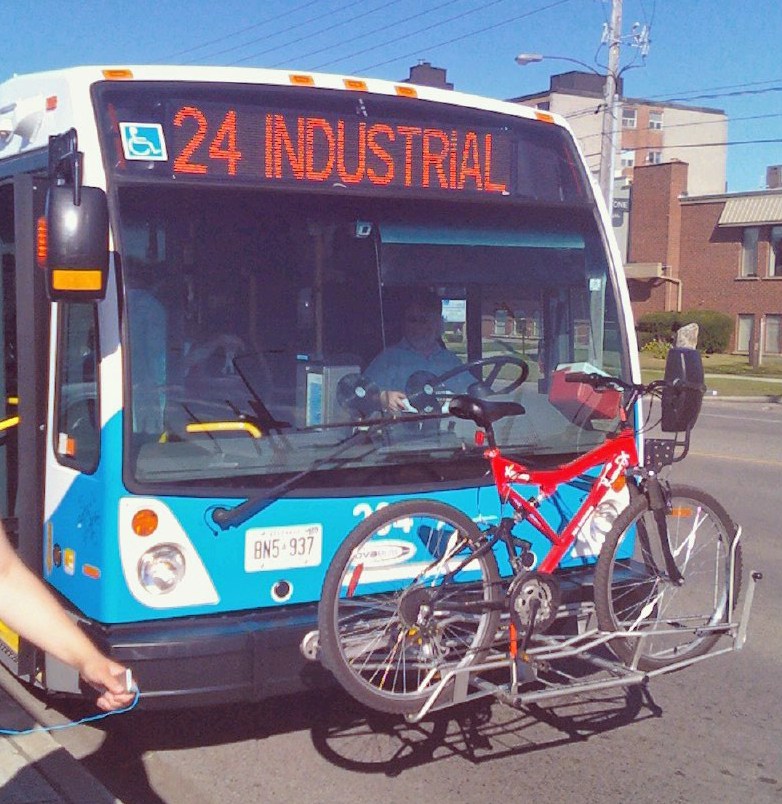
My Bus.

My bus ride home. Not my bike though.

With my bike in the shop for a couple of days for a tune-up and new tires I’m riding the bus once again. Now, this is not a new experience, I ride the bus daily about 5 months a year; however, every time I ride the bus during cycling season I’m struck by how different everything looks.

When I’m on my bike my focus is, of course, on the traffic. I’m watching for where the cars are every minute because, for the most part, they aren’t looking for me. With one eye on traffic, the other eye is on the pavement ahead of me watching for potholes, sewer grates, broken glass etc. My Hardcase® tires are tough, but they aren’t impenetrable; they take a hit once in a while. As a result there isn’t a lot of time for taking in the surroundings when I’m rolling through traffic on my way to work.

On the bus however, it’s a different matter. With someone else doing the driving, I’m free to put on my headphones, call up a playlist on my phone and take in the world around me for 40 minutes. (Yeah, it takes that long. Longer than it takes me to cycle actually. But that’s another post. Back to the bus ride…)

This morning I noticed the new porch on the house on the corner where I broke my collarbone when I was 10 years old. I noticed the French announcement of the end of the school year at Paisley Road School where I went as a kid.  I noticed what a great soundtrack for the bus ride Jon Buller’s Hum Along makes. (BTW.. If you’re listening to headphones/ear buds while cycling you are asking to get hit by the traffic you can’t hear. Don’t do it!)  And I noticed that the Universe is continuing to taunt me unmercifully.

Why do I say that? Well, my doctor tells me part of the solution for my GI issues is to lay off the coffee! I know, it’s a painful change, but I must admit the pain in my gut has all but disappeared since I stopped drinking my favorite organic suspension. And what does the Universe do in response to this difficult transition in my life? It opens a new Planet Bean® right on my way to work!!  – (Thou know’st, the first time that we smell the air we wawl and cry. King Lear Act 4, scene 6) I’m truly convinced that from time to time the Universe does indeed have it in for me.

I noticed a lot of other things too; people, buildings, situations that would have otherwise stayed out of my line of sight had I been riding my bicycle. It was refreshing to look at the world I passed through every day from a different perspective.  Oh, and I noticed one more thing as well;  my opportunity to gain this new perspective was totally due to the fact I was no longer in control.

You see, when I’m riding I’m in the driver’s seat. I have things to do, details to manage; my focus is entirely on the destination, the route and the obstacles. But on the bus, those details are no longer my concern. Someone else is sweating the route, the traffic and the potholes affording me the opportunity to look around and enjoy the ride. And as this all unfolded around me I realized – you can’t gain a new perspective while your attention is focused on doing what you’ve always done.

I found myself wondering how many areas our lives is letting go of the reins a part of gaining a new perspective. Does a parent gain new insights into how their child thinks and functions when they step back and let the hockey coach do the interacting? Will letting a co-worker head the task force give an office manager a chance to see the bigger picture? How much more could we learn about who we are and what we do if we allowed others to take the lead?

I had a similar experience at Guelph Little Theatre this past month. Instead of getting down to the nitty-gritty of picking out all the sounds and music etc. for the One Acts Festival my role this time was more of a mentoring one. A very talented young woman named Amanda was in the trenches; my job was to familiarize her with the systems we employ and then let her do the job, stepping in only when she entered unfamiliar territory. I’ll admit it was hard to keep my hands out of things because doing the work is what I really enjoy. But that would have taught Amanda next to nothing. So I forced myself to step back and let her take the reins, stepping in only when she encountered something for which she had no experience.

The result was a chance to get a renewed perspective on how sound fits into the bigger picture. There were no new startling revelations, but there was a chance to reaquaint myself with aspects of the job that often get taken for granted and as a result sometimes get overlooked or short-changed. I was grateful for the experience and consider it one of the more rewarding things I’ve done at GLT.

I think the same holds true for our spiritual lives as well. Consider Psalm 55:22, “Cast your burden on the LORD, and he will sustain you; he will never permit the righteous to be moved.”

Many of us are so tied up in trying to manage the details of our lives we never yield control long enough to look at things from God’s perspective. We ask ourselves, “What would Jesus do?”, but is that really what we need to be asking? Is it possible that what we need to do is let go of the handlebars, let God drive and look at the world from the back of the bus? As long as we are focusing on trying to figure out what to do, our minds are too occupied to be able to gain any other perspective, especially God’s.

A good example is what I’ve been going through at my home church these past few months. Many of us prayed that the introduction of a new minister would be an opportunity for God to do something new at KPC. We coined the term Kortright 3.0 and looked forward to a new chapter in the life of the church. When Alex first showed up not much changed as he was still getting the lay of the land, but recently he has started to steer us in new directions. They are not great changes but they are different in many ways from what we are used to. And a predictable-but strange none the less-thing happened. We resisted!

Well, some of us anyway. Even though we had been praying for God to do something new, some of us still felt our skin crawl when the changes began to take place. It seems that we are resistant to change even when we ask for it! Why?

I think I know why.  Though some of us probably won’t admit it, the reason is because we aren’t really resisting the idea of change; what we are resisting is loss of control. We don’t want to let go because we aren’t all that comfortable letting someone else drive. But if we are to embrace what God is doing in our lives we need to let go and let someone else, namely Him, drive. Once we do then we can sit back, look at the situation without the burden of command, and gain a new perspective on things and eventually learn to enjoy the ride.

And when the time comes that God’s perspective has becomes ours, we’ll probably find He’s content to let us take the wheel once again.

Until next time… Shalom.

Horns of a Dilemma

As I listen to the rhetoric start to ramp up as we slowly careen toward the provincial election in October, I find myself once again torn on the subject of who to throw my vote away on.  Do I sound cynical? Well, that’s likely because more and more I find politics so generally reprehensible that elections are starting to resemble the process where the prisoner gets to choose their mode of execution; one way or the other, you’re still dead.

My dilemma largely starts with the fact that I can’t define myself neatly on either the left or the right politically. While I have a number of conservative tendencies, I also support many policies traditionally associated with the left. The result is I’m not allowed the luxury of being able to stamp my forehead with a party logo and lock myself mindlessly in step with whatever drivel drools out of the party leader’s mouth. I am forced to examine the evidence, consider all the ramifications and try to come to a rational decision as to which political entity is least likely to cause Canada, or in this case Ontario, to follow the same course as say, Greece.

Let’s take Dalton’s tax record for example. Tim Hudak and the PC Party of Ontario love to point out that Dalton promised not to raise taxes and then promptly introduced the Health Premium; essentially a tax to help pay for health care in Ontario. As a recent cancer survivor I find myself less upset about this lie than I used to be.

In the last nine months I have had 4 CT scans, 3 x-rays, 2 MRIs, 36 radiation treatments, 2 surgeries, 1 colonoscopy and 26 office appointments with a GP, an ear/nose and throat specialist, two surgeons, an oncologist, and a GI specialist and throughout it all the only cash I had to fork out personally was cab fare.  I have no idea how much all of that costs. I’m not even sure I’d like to know as I am sure it’s a frightening figure; but if you were to tell me that the reason none of that cost had to come out of my own pocket was Dalton’s Health Premium, I wouldn’t quibble with you for a second.  MRIs and CT scans and Radiation machines are expensive and the money has to come from somewhere and asking me to pony up my share is entirely reasonable.

But lying about it isn’t. According to the CQCO (Cancer Quality Council of Ontario) if you are diagnosed with cancer in Ontario you have “one of the best chances of survival anywhere in the world.” [ref] And the billions we spend on health care here is the reason why; not to mention the millions raised by events such as the Ride to Conquer Cancer.  This is something we should be proud of and celebrate, but our leaders still find it hard to just be open about it and say, “Look, it costs billions to make health care happen and taxes are the main source of that money.” Then make sure you taxation strategy is fair and balanced.

But when you lie about it and try to hide it and obfuscate the details so that people who disagree with you are more likely to vote for you it does not inspire any level of confidence even if the result is largely positive. Give the public some credit and simply tell us how much stuff costs and how you’re going to pay for stuff up front. So while I understand the need for the tax, lying about it does not increase my willingness to vote Liberal.

That said, I’m also sure there’s a big slice of those billions are being pissed away paying consultants and contractors and others way too much to do things that have been done before and accomplish very little that actually results in more people getting colonoscopies, surgeries, and visits to the doctor’s office.  I’m sure of this because I know from experience that’s the way far too many bureaucracies work (remember eHealth), and b) that’s the way far too many consultants manage to stay in business (again eHealth).

I am also fairly sure there are savings to be found on the front lines as well. I used to work security for one of the hospitals in Guelph and was curious as to why the guy mowing the lawn got paid as much as the orderlies did. One of the staff in the administration office told me it was because “of the extra training and skills required to do the job in a sterile hospital environment.” I will never forget that line.  Mow the Lawn? In a sterile hospital environment? Really?? 

And yet, while I’m sure cutting health care costs is on Hudak’s agenda, most of what he has said so far leaves me convinced that I can’t trust him to be selective enough in his cutting to do any real good. Rather than separate the wheat from the chaff, I can easily picture him just burning the whole field; leaving me unable to confidently vote PC either.

So you see my dilemma, no matter which option I choose I’m fairly certain the end result will be a horn up my butt. And not just with health care. A similar each-one-is-as-bad-as-the-other scenario can be demonstrated for just about every aspect of my existence.  My only hope seems to be that somewhere in the next hundred days one or the other of them will screw up so bad the decision will be made for me.

Until next time… Shalom