My Favorite Day

For the past few days, like many of you I imagine, I’ve been thinking a lot about 9/11 – starting with how it doesn’t seem like it’s been 25 years. That and how much the world has changed since then. 

I watched the memorials – New York, Washington, Gander. I’ve read the blogs, articles, and essays. I’ve clicked on the YouTube, Tik Tok, Instagram, Threads and Facebook posts. It drew my attention all weekend. And through all of it, one thought stands out above all the rest. 

It doesn’t matter who you are, where you were, or even if you were alive yet that day. Your politics, your religion, your nationality, your race; none of it changes the most important lesson we all, every one of us, need to learn from what happened.

You are never more than one unexpected event away

from having your entire world change forever.

It likely won’t be a terrorist attack, I pray it isn’t. It may be a phone call, a wrong turn, a missed appointment, a medical diagnosis. It may not even be a bad thing. It might be a brief encounter with a friend, or a stranger; on the bus, at the cash register, or just walking down the street. 

But it will be a change, one that you didn’t see coming, and your life will never be the same.

So, how do we prepare for this possibly inevitable change?  

We can’t. It’s the very nature of “unexpected”. But that doesn’t mean there’s nothing we can do. As the great philosopher Pooh of Pooh Corner put it….

“What day is it?” asked Pooh.

“It’s today,” squeaked Piglet.

“My favorite day,” said Pooh.

Live in the moment.

Cherish today, especially the people in it.

Don’t wait to tell someone you love them.

Don’t ignore an opportunity to be kind.

Don’t let fear keep you from your dreams.

Carpe Diem – Seize the day!

The events of 9/11 remind us that life is fleeting. It can change in a moment.

Enjoy it while you can.
Red Letter Christians » A Desperate Need for Imagination

Shane Claiborne takes an intriguing slant on Romans 12 and the subject of creativity, innovation and the renewing of our minds in Christ. It is well worth the read.  My favorite quote:

“For too long the Church has promised the world life after death, while a dying world has been asking, “But is there life before death?” I am convinced the Kingdom of God is not just about going up when we die, but about bringing God’s dream down to earth.”

Check it out at Tony Campolo’s ‘Red Letter Christians’…

Red Letter Christians » A Desperate Need for Imagination.

Shalom…

Towards Cycling Culture

As I make my way down the final stretch to the Ride to Conquer Cancer, I find myself pondering the move towards cycle culture in North America and why it isn’t more like Europe?

For the last year or so I’ve been following a blog called Copenhagenize.  Written by an ex-Calgarian now living in Copenhagen, it and it’s sister site Copenhagen Cycle Chic chronicle how Danish cycle-culture is progressing and Copenhagen in particular should be the model the rest of the world uses to shape cycling infrastructure in the big cities. To be fair, there’s a great deal I like about what Mikael has to say, and I certainly would like to see Canada follow more of the Danish example when it comes to cycling infrastructure; separated bike lanes, extensive bicycle parking at malls and public buildings, elimination of helmet laws, etc.  But there is one major difference between Europe and North America that will likely always stand in the way.

Europe moves at a much slower pace.

It’s a mindset thing. Throughout most of Europe things happen when they happen. Deadlines are largely regarded as suggestions, stress relief often involves coffee in a street cafe in the middle of the afternoon, shops will even close in the middle of the day to take in a soccer game or a concert.  The trip to the shop or office is as much an experience as being there.

Not so in North America.  Here it’s all about getting as much done as possible in as short a time as possible.  Fulfillment is found not in relishing every moment of an experience but rather in cramming as many experiences into the moment as possible.  North America has always had a quantity over quality mindset. The daily commute, the trip to the store is a means to an end and nothing more. We get from A to B is as few steps as Google Maps can lay out for us and it better not take one second longer than the estimate.

Even what passes for cycling culture reflects this.   The mainstay of the European bicycle commute is the city-bike.  Ridden by men and women alike it allows one to travel in style; long coats, skirts, pumps and even stilettos are suitable cycling fashion. For families, the bakfeit or cargo bike allows mom or dad to ferry the kids around in safety without ever having to take the eyes of the hope of the future.

In North America however, it’s all Spandex and helmets, 27 speeds and razor thin tires, beat the rush and get to the office in time to grab a shower and wash away the record setting attempt at getting to work.  Kids interrupt air-flow so tuck ’em in back or park ’em in a trailer out of sight so we can focus on the road ahead.  Slow bikes are as much an annoyance as slow drivers and cycle chic is measured in Day-Glo jerseys and the latest high-tech shoe clips.

As long as this is the case I’m afraid that cycling culture in Canada will always be at war with the cars.  Bicycles don’t mesh with North Americas high speed lifestyle. It’s hard to embrace the bicycle when you want to be everywhere 10 minutes before you left and want to take half the house with you in case you need something.

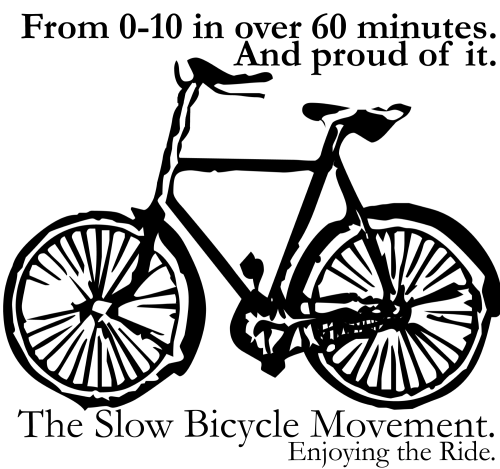
Slow Bike Movement

Slow Bike Movement

If North America is ever going to move towards a vibrant effective bicycle culture the first thing it needs to do is slow down. Not just on the roads but in the way we approach life itself.

“Slow down, you move too fast.
You got to make the morning last.”

See you in Niagara Falls —