Looking Forward to a Day in Hamilton

JCC totebag

My JCC tote-bag. One souvenir I cold do without.

Okay. I’m back from the latest trip to the clinic in Hamilton and here’s what’s what.

They did in fact find the cancer – it was hiding in my right tonsil. Seems they got the sucker when they took my tonsil out. They were just going in for a look-see because they suspected it might be there, and lo and behold it was. However, since this was just your garden variety tonsillectomy (in case they were wrong I guess) they did not burn out as much of the surrounding area as they would have done if they knew for sure they were removing a cancerous-type tumor.  And since the cyst proved little pieces of this thing are floating around in my lymphatic system, we must not leave anything to chance; so…

On with the radiation therapy! (Oh joy) I head back down Thursday next (Dec. 9th for those of you keeping notes) and engage in a day full of fun and excitement.

1st up – a trip to the surgeon’s at 9:30 am. (or 9:50 am – can’t read my wife’s hand writing and neither can she.  Will have to make a phone call on this one Monday) to make sure the charred flesh in my throat is healing nicely. That’s right, we want to be sure that my throat has fully recovered from the last atrocity inflicted upon it before we subject it to another one.

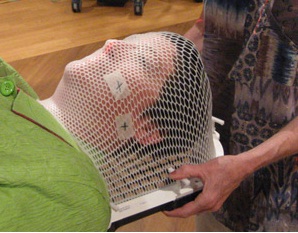
2nd on the itinerary – The Man in the Plastic Mask – Act 1.  At 11:15 a.m. our healthy, medically certified, and CLEAN-SHAVEN  hero (me) arrives up at the Juravinski Cancer Centre to get a cast made of my face using a special plastic mold. This will be used to keep yours truly from twitching while these high-tech William Tells try to shoot a cancer laden apple off my head with an arrow made of radiation. If I flinch we might wind up with an outcome decidedly different from the opera. Ouch! (Yes, I’m mixing my theatrical allusions here but I really don’t care.)

3rd in line – Lunch.  Apparently it takes an hour and a half for the cast to harden; during which time I am invited to have lunch, take a walk, whatever, so long as I am back for the second act.

4th item – The man in the Plastic Mask – Act 2.  Once the cast has hardened we return to the clinic where a CAT-scan of me in the mask will be taken. This will in turn be used to plot out the course of my radiation therapy sessions and pin-point EXACTLY where those aforementioned radioactive arrows will intersect with my anatomy. Then the mask will be marked with the indelible ink targets, instead of my face.

That done I am set free to roam the earth until the actual radiation treatments begin about 2 weeks later (specifics to follow on Dec. 9th) I am told all will proceed without incident for the first few weeks of treatment, after which the side effects will kick in and I’ll wish my mother had never given my father his first kiss (or some other event that would have precluded my birth so as to avoid all this unpleasantness).

Well, that’s the sum total of the information I have for now. This should be more than enough for the prayerful, the genuinely concerned, and the just plain curious until we write the next chapter. See you Dec 10th.


The Meaning of Life

As some of you know, I have recently been diagnosed with cancer. Yeah, it sucks. I’ve been trying to blog about it, but so far nothing I wrote ever seemed quite – right. So the subject remained untouched, till now.

Over the last few days I’ve been praying and thinking about the situation a lot and, not unsurprisingly, found myself pondering the ‘meaning of life’ – mine in particular, and what the future might hold, both during the radiation treatments and after. Just when I thought God wasn’t going to give me any insight right away, I was reminded of a story I haven’t read in years. I went looking for it to read again and after having don so found it fit the moment perfectly. Surprise, God was paying attention after all. (Just kidding – of course He was.)

It’s called The Three Questions; it’s a short story written by Leo Tolstoy and since it’s in the public domain now I present it to you in it’s entirety below. It’ll only take about 5 minutes or so to read, and says more about where I am right now than I ever could.

So, grab a cuppa joe (or tea for that matter) and take the time to read it. Regardless of your philosphical or religious leanings I think you’ll agree it’s hard to argue with Tolstoy’s answers.

Shalom

————

The Three Questions

By Leo Tolstoy

It once occurred to a certain king, that if he always knew the right time to begin everything; if he knew who were the right people to listen to, and whom to avoid; and, above all, if he always knew what was the most important thing to do, he would never fail in anything he might undertake.

And this thought having occurred to him, he had it proclaimed throughout his kingdom that he would give a great reward to any one who would teach him what was the right time for every action, and who were the most necessary people, and how he might know what was the most important thing to do.

And learned men came to the King, but they all answered his questions differently.

In reply to the first question, some said that to know the right time for every action, one must draw up in advance, a table of days, months and years, and must live strictly according to it. Only thus, said they, could everything be done at its proper time. Others declared that it was impossible to decide beforehand the right time for every action; but that, not letting oneself be absorbed in idle pastimes, one should always attend to all that was going on, and then do what was most needful. Others, again, said that however attentive the King might be to what was going on, it was impossible for one man to decide correctly the right time for every action, but that he should have a Council of wise men, who would help him to fix the proper time for everything.

But then again others said there were some things which could not wait to be laid before a Council, but about which one had at once to decide whether to undertake them or not. But in order to decide that, one must know beforehand what was going to happen. It is only magicians who know that; and, therefore, in order to know the right time for every action, one must consult magicians.

Equally various were the answers to the second question. Some said, the people the King most needed were his councillors; others, the priests; others, the doctors; while some said the warriors were the most necessary.

To the third question, as to what was the most important occupation: some replied that the most important thing in the world was science. Others said it was skill in warfare; and others, again, that it was religious worship.

All the answers being different, the King agreed with none of them, and gave the reward to no one. But still wishing to find the right answers to his questions, he decided to consult a hermit, widely renowned for his wisdom.

The hermit lived in a wood which he never quitted, and he received none but common folk. So the King put on simple clothes, and before reaching the hermit’s cell dismounted from his horse, and, leaving his body-guard behind, went on alone.

When the King approached, the hermit was digging the ground in front of his hut. Seeing the King, he greeted him and went on digging. The hermit was frail and weak, and each time he stuck his spade into the ground and turned a little earth, he breathed heavily.

The King went up to him and said: “I have come to you, wise hermit, to ask you to answer three questions: How can I learn to do the right thing at the right time? Who are the people I most need, and to whom should I, therefore, pay more attention than to the rest? And, what affairs are the most important, and need my first attention?”

The hermit listened to the King, but answered nothing. He just spat on his hand and recommenced digging.

“You are tired,” said the King, “let me take the spade and work awhile for you.”

“Thanks!” said the hermit, and, giving the spade to the King, he sat down on the ground.

When he had dug two beds, the King stopped and repeated his questions. The hermit again gave no answer, but rose, stretched out his hand for the spade, and said: “Now rest awhile-and let me work a bit.”

But the King did not give him the spade, and continued to dig. One hour passed, and another. The sun began to sink behind the trees, and the King at last stuck the spade into the ground, and said: “I came to you, wise man, for an answer to my questions. If you can give me none, tell me so, and I will return home.”

“Here comes some one running,” said the hermit, “let us see who it is.”

The King turned round, and saw a bearded man come running out of the wood. The man held his hands pressed against his stomach, and blood was flowing from under them. When he reached the King, he fell fainting on the ground moaning feebly. The King and the hermit unfastened the man’s clothing. There was a large wound in his stomach. The King washed it as best he could, and bandaged it with his handkerchief and with a towel the hermit had. But the blood would not stop flowing, and the King again and again removed the bandage soaked with warm blood, and washed and rebandaged the wound.

When at last the blood ceased flowing, the man revived and asked for something to drink. The King brought fresh water and gave it to him. Meanwhile the sun had set, and it had become cool. So the King, with the hermit’s help, carried the wounded man into the hut and laid him on the bed. Lying on the bed the man closed his eyes and was quiet; but the King was so tired with his walk and with the work he had done, that he crouched down on the threshold, and also fell asleep–so soundly that he slept all through the short summer night. When he awoke in the morning, it was long before he could remember where he was, or who was the strange bearded man lying on the bed and gazing intently at him with shining eyes.

“Forgive me!” said the bearded man in a weak voice, when he saw that the King was awake and was looking at him.

“I do not know you, and have nothing to forgive you for,” said the King.

“You do not know me, but I know you. I am that enemy of yours who swore to revenge himself on you, because you executed his brother and seized his property. I knew you had gone alone to see the hermit, and I resolved to kill you on your way back. But the day passed and you did not return. So I came out from my ambush to find you, and I came upon your bodyguard, and they recognized me, and wounded me. I escaped from them, but should have bled to death had you not dressed my wound. I wished to kill you, and you have saved my life. Now, if I live, and if you wish it, I will serve you as your most faithful slave, and will bid my sons do the same. Forgive me!”

The King was very glad to have made peace with his enemy so easily, and to have gained him for a friend, and he not only forgave him, but said he would send his servants and his own physician to attend him, and promised to restore his property.

Having taken leave of the wounded man, the King went out into the porch and looked around for the hermit. Before going away he wished once more to beg an answer to the questions he had put. The hermit was outside, on his knees, sowing seeds in the beds that had been dug the day before.

The King approached him, and said: “For the last time, I pray you to answer my questions, wise man.”

“You have already been answered!” said the hermit, still crouching on his thin legs, and looking up at the King, who stood before him.

“How answered? What do you mean?” asked the King.

“Do you not see,” replied the hermit. “If you had not pitied my weakness yesterday, and had not dug those beds for me, but had gone your way, that man would have attacked you, and you would have repented of not having stayed with me. So the most important time was when you were digging the beds; and I was the most important man; and to do me good was your most important business. Afterwards when that man ran to us, the most important time was when you were attending to him, for if you had not bound up his wounds he would have died without having made peace with you. So he was the most important man, and what you did for him was your most important business.

Remember then: there is only one time that is important– Now! It is the most important time because it is the only time when we have any power. The most necessary man is he with whom you are, for no man knows whether he will ever have dealings with any one else: and the most important affair is, to do him good, because for that purpose alone was man sent into this life!”

Don Pardo, Tell Him What He’s Won!

Well, it seems that no good deed goes unpunished has a reciprocal – no stupid plan goes unrewarded!

Terry Jones, the Florida pastor who was going to burn the Koran to mark Sept. 11th will receive a brand new car from a dealership in New Jersey. Now, to be fair, the dealer promised he would as a means of getting Jones to abandon his plan and, like any good Christian, he’s keeping his word. My problem is with a) making the offer in the first place, and b) by calling to collect on the deal Jones continues to reveal his true nature.

It’s no wonder the world at large has such a distorted view if Christianity. The original plan laid out by Jesus, as I understand it, was to create a fellowship of believers that were different from the world around us; different even from others who claimed to follow the God of Abraham, Issac and Jacob. It was His intention that the world would notice us by the fruit of His Spirit within us: love, joy, peace, etc.

And yet, time after time, pastors, teachers, evangelists, and everyday believers demonstrate no difference at all between them and the world they oppose. Hatred, egotism, bribery, distrust, violence – all these are far too often the tools the “church” uses to spread the gospel. Is it any wonder that so many people see no reason to consider Jesus.

Why would they when they look at his followers?


A Lesson in Faith

Like many of you I was watching the Chilean miners being brought to the surface the last few days; mostly from my hospital bed after surgery to remove a cyst. What struck me most was the number of men who thanked God for their deliverance along with the engineers and others who made it possible. That these spiritual accolades were more than mere words was made evident by the clutching of Bibles, the sign of the cross, and in one case, a miner taking the time to kneel in prayer before moving on from the place of his extraction. I was moved to tears more than once.

Though my situation was no where near as dire and that of the miners I too felt the strength that comes from my faith. Please understand I make absolute no comparison here between my situation and that unfolding in Chile. But also understand that as I laid in the hospital, the knowledge that there were people out there praying for me made even my minor challenges more manageable.

Our culture is inundated these days with the message that our faith is worthless, that we pray to a God that doesn’t exist.  The skeptics will look at the events at the San Jose Mine and tell you the same outcome would have resulted if there had been no prayer, no Bibles, no spiritual references, just the indomitable human spirit to survive.

I doubt it!

What these men have gone through is beyond imagining. As their stories unfold of the next few months, a nearly endless list of magazine articles, interviews, a few book deals and at least one feature film I’m sure, I am sure the majority of them will tell of how the strength to survive this ordeal came, not from within, but from each other and from somewhere far outside of themselves. The events surrounding the rescue of the Chilean miners are a study in faith and it’s power to strengthen the human spirit with the indwelling of the Spirit of God.

There is much to be learned here. My fervent hope and prayer is that the media will not shy away from the religious context but rather examine its role closely and allow that lesson to be heard, unedited and without editorial comment.

Beware the Dark Side

[Note: This post is part of a series on Science Fiction and Spirituality that had its genesis HERE.]

Yoda: “Yes. A Jedi’s strength flows from the Force. But beware the dark side. Anger, fear, aggression. The dark side of the Force are they. Easily they flow, quick to join you in a fight. If once you start down the dark path, forever will it dominate your destiny. Consume you it will, as it did Obi-Wan’s apprentice.

Luke: “Vader… Is the dark side stronger?
Yoda: “No, no, no. Quicker, easier, more seductive.[1]

Nearly one hundred years before the above conversation took place on the silver screen, a young Scottish novelist and poet used the genre of science fiction to explore the dark side of the human psyche. His name was Robert Louis Stevenson. The novella in question – Strange Case of Dr. Jekyll and Mr. Hyde. [2]

The duality of human nature has found its way into many of our stories;  you’ll find it in fables, doppelgänger literature, devil tales and gothic novels to name but a few. It should come as no surprise then that during the Victorian age of reason, the notion of a scientific solution to the duality of humanity should appear in literature.

In Stevenson’s tale, Dr. Henry Jekyll is troubled by the side of his personality that finds pleasure in the ideas and activities that Victorian society frowns upon. Though the apostle is never quoted, Jekyll’s mood very much echoes the sentiments of Romans 7:22-23 – “For in my inner being I delight in God’s law; but I see another law at work in the members of my body, waging war against the law of my mind and making me a prisoner of the law of sin at work within my members.”

Being a scientist, convinced that such proclivities are chemical in nature, Jekyll seeks a potion that will isolate the dark side of his nature and allow the good in him to rule unopposed.  He succeeds, after a fashion, but while he has managed to separate the good from the evil, it is the dark side that takes over his waking hours to the point of deforming Jekyll’s physical appearance as well. The result is the amoral and self-indulgent Mr. Edward Hyde.

The novel actually chronicles the experiences of Jekyll’s good friend & lawyer Gabriel John Utterson after he witnesses the bizarre act of a man trampling over a small girl and then compensating her family with a cheque written by Utterson’s friend Henry Jekyll. The nature of the connection between Hyde and Jekyll continues to elude Utterson as he discovers other tales of Hyde’s immoral behaviour.

The bulk of the novella therefore, centres on Utterson’s efforts to convince Henry that Hyde is a scoundrel and all connections to him should be severed immediately. It is not until the last two chapters, after Hyde’s apparent suicide, that Utterson discovers his good friend Henry and the despicable Hyde are in fact one and the same person. (This suspense generating device of keeping the reveal until the end is a feature of the novel rarely used in the various movie adaptations. As a result the story is often thought of as a horror tale rather than as science-fiction.)

The dilemma facing Henry Jekyll is one that is common to all humanity; we aspire to a level of character that is noble, good and worthy of the admiration of our fellow citizens, and yet there is at the same time a desire for the baser things in life.  We find ourselves overcome by the desire for pleasure, we crave it, seek, lust after it, even when we know that to indulge it will ultimately lessen the quality of our lives. Short term stimulus takes presidence over long-term well-being. It is the very nature of addiction, and we are all subject to it, regardless of class, education, or breeding.

It is also the foundation of every religion in the history of mankind.  The subject of eternity and the afterlife may indeed be prominent in many cases, but the bulk of all sacred writing, be it the Theravada, the Torah and Talmud, the Sruti, the New Testament, or any of a hundred others, is focused on successfully overcoming the struggle between our dual natures.  Religion, indeed spirituality of all forms, seeks to guide us in the everyday struggle to conduct ourselves in a manner that positively impacts our surroundings while not abandoning our own needs. It is variously described as a narrow path, a balance between forces, and a tightrope walk.

The story of Jekyll and Hyde then becomes an expression of the desire to relieve ourselves of the struggle; to ease the burden by taking self-control and personal effort out of the equation and relying on science, specifically a drug, to solve the problem for us. If we could simply remove the temptation, isolate the two natures and give the nobler side unfettered control, the struggle would be over.

But freedom, our hero discovers,  is a two-way street. If good lies unfettered then so too does evil, and as Yoda observed while evil is not stronger it is, “Quicker, easier, more seductive.” The lesson of Stevenson’s story, though I’m not sure he intended it to be, is that there is no short-cut to a moral character and an upright life. It requires that we devote ourselves to a religion, a spirituality of some kind that has its origin outside of ourselves from where we can draw strength to survive the struggle, and hopefully win it.

So we see then that even though science-fiction may rarely quote scripture of invoke God’s help in resolving a plot line, the sci-fi story is quite often a morality play, forcing us to consider life in ways we may not have indulged before, and whenever a person seriously considers the nature of their own existence, the opportunity exists for God to reveal Himself to them. And in this I rejoice.

Totally Aside but an Interesting Little Tidbit Dept: – Not long after the publishing of this story, Stevenson moved to the South Pacific, cruising for a number of years on a yacht named the Casco. During this time he visited the leper colony at Molokai and befriended the famous Father Damien. Such was the relation ship that when a Honolulu Presbyterian minister attacked the character of Father Damien, Stevenson wrote a scathing open letter of rebuke. The name of the object of his displeasure – the Rev. Dr. Hyde.

Until next time – Shalom.

—–

[1] from: Star Wars Episode V: The Empire Strikes Back, Lucasfilm, 1980

[2] Original title. In modern publications “The” is added to the title to make it grammatically correct, but in the original publication Stevenson was explicit in his desire to omit the definitive article.