PLease Don’t Confuse Me with Facts!

I subscribe to a number of daily & weekly blogs via Google Reader. It saves me a lot of time and ensures that I don’t miss anything from my favorite writers. This morning I got this from geeksaresexy.com

Why are some Christians so afraid of science.

Why are some Christians so ignorant & afraid of science.

I will never understand why some Christians are A) so incredibly ignorant of basic science and logic, B) so afraid of science they really don’t want to know anything.

Take the above example. First of all let’s look at the original statement of so-called fact.

“Fact – if the earth was 10 ft closer to the sun we would all burn up and if it was 10 ft further we would freeze to death… God is amazing!!”

Yes God is amazing – I’m amazed he doesn’t hurl more thunderbolts when his followers come up with this kind of drivel. Seriously! TEN FEET!!! How can anyone actually believe this? It doesn’t take an astrophysicist to realize that is this were actually true then life on earth would have died off before Adam and Eve got themselves kicked out of The Garden.  Or at best life could not exists outside a narrow band between  10 ft. above and 10 ft. below sea-level.

The first thing they taught us in grade 6 science was the difference between mean distance and average distance and just how much wobbling there is out there when it comes to things like planets and moons and stars and such. One really has to wonder how any educational system more than 10% functional could produce this kind of scientific ignorance.

But the real problem here is not that God-is-awesome-guy can’t comprehend basic physics; it’s his reaction when someone points out the flaw in his logic.

“Okay, thats cool and alll but dont ever comment on my status telling me that i am wrong everrr again. I didnt ask you did i? Answer: NO” [sic]

This is what really bugs me about this post and the entire God vs Science debate (as if God and science have nothing to do with each other). What has happened to the church in the last century to make such a large portion of it so afraid of science? And why is it so many of those who claim to follow one of the gentlest, kindest, most polite people ever (Jesus wasn’t even rude when talking to those who were out to kill him) are such blatantly rude ignoramuses.

This isn’t the first time I have encountered this among God’s people. Back in the Eighties I had a pastor once try to tell me that human beings never, ever under any circumstances lived in caves. That the whole cave-dweller idea was part of the conspiratorial lie that is “evilution” (Yeah – he actually pronounced it that way every single time he said the word).

When I asked him to explain the overwhelming preponderance of evidence that indicated large numbers of human communities lived in caves all over the world, his response was, “Even if it is true, I don’t want to know about it. I prefer my own reality, the facts be damned.” (Exact quote folks. It was so absurd a statement I will never forget it.)

I’ve heard other pastors, elders, evangelists and everyday Christians make similar declarations. “I don’t want to hear the facts. If I’m wrong, I don’t want to know it.” What worries me most is I can only think of one place where this attitude can possibly have come from – insecurity.

That’s right – insecurity! You see, while a number of these people will tell you they hold fast to this position because they are strong in their faith and refuse to buckle under to the lies of science; I think the exact opposite is true.  If your faith is so strong then why must it run away from the facts.

Okay, I know that right now there are a large number of you screaming, “But evolution isn’t a fact – it’s a lie.” First of all – calm down. I’m not talking evolution here – I’m talking science in general. The above example has nothing to do with evolution – it’s a simple matter of math & physics. But even if it was about evolution, why run away from the debate with ridiculous statements like these?

Why can the church not engage in reasonable, intelligent debate instead of meaningless rhetoric that accomplishes nothing other than to shore up the argument that religion is the last retreat of the ignorant and uneducated. It just adds fuel to the fire; it doesn’t solve anything.

I’m really at a loss to understand where this recent fear of science comes from and belive me, it is recent.  As I’ve pointed out in earlier post regarding science fiction, such was not always the case. In previous centuries when science revealed new information about how the earth was made and how nature functions the response of many of these believing scientists was to marvel at the intricacy of God’s creation. In their journals and letters they revel in what they regarded as proof of an intellegence far beyond imagining being at the heart of the universe.

Their faith was not challenged. They didn’t cease to believe. They instead looked at the facts before them, looked at the Word revealed to them and studied to understand how the two come together. When they failed to be able to reconcile them it was not an indication that either science or faith were wrong, but rather an admission that we still need to study harder before understanding could be realized.

When did we stop doing this? When did it become acceptible to check your brain at the door before entering the church?  That’s not to say that there isn’t a good deal of dogmatic ignorance on the side of science as well, there is.  But I not being a scientist I can’t speak to that.

But I feel I can speak to the church, and once again I come back to the question of insecurity. I believe my faith is strong because there is nothing science can reveal to me about how the universe works that will shake it. And I don’t need to run away from it. I want to know how the universe spins. I want to know the world that God created because it all reveals to me something about who God is.

Sometimes it does challenge my understanding of exactly who God is, but never my firm belief that God exists. I harbour no pretentions that I fully understand all there is to know about God or the universe He created. My theology, like everything else about me is a work in progress, a constant state of being and becoming that will never be a stagnant pool but always a flowing river. The shape of it will change with each new turn, each eddy and tributary along the way. Some of the changes will happen because of what I read in the Word, some because of what I read in the earth, but through it all God remains the same.

If your faith avoids rather than faces the challenges that come along, how can growth ever happen?

Shalom…

The Meaning of Life

As some of you know, I have recently been diagnosed with cancer. Yeah, it sucks. I’ve been trying to blog about it, but so far nothing I wrote ever seemed quite – right. So the subject remained untouched, till now.

Over the last few days I’ve been praying and thinking about the situation a lot and, not unsurprisingly, found myself pondering the ‘meaning of life’ – mine in particular, and what the future might hold, both during the radiation treatments and after. Just when I thought God wasn’t going to give me any insight right away, I was reminded of a story I haven’t read in years. I went looking for it to read again and after having don so found it fit the moment perfectly. Surprise, God was paying attention after all. (Just kidding – of course He was.)

It’s called The Three Questions; it’s a short story written by Leo Tolstoy and since it’s in the public domain now I present it to you in it’s entirety below. It’ll only take about 5 minutes or so to read, and says more about where I am right now than I ever could.

So, grab a cuppa joe (or tea for that matter) and take the time to read it. Regardless of your philosphical or religious leanings I think you’ll agree it’s hard to argue with Tolstoy’s answers.

Shalom

————

The Three Questions

By Leo Tolstoy

It once occurred to a certain king, that if he always knew the right time to begin everything; if he knew who were the right people to listen to, and whom to avoid; and, above all, if he always knew what was the most important thing to do, he would never fail in anything he might undertake.

And this thought having occurred to him, he had it proclaimed throughout his kingdom that he would give a great reward to any one who would teach him what was the right time for every action, and who were the most necessary people, and how he might know what was the most important thing to do.

And learned men came to the King, but they all answered his questions differently.

In reply to the first question, some said that to know the right time for every action, one must draw up in advance, a table of days, months and years, and must live strictly according to it. Only thus, said they, could everything be done at its proper time. Others declared that it was impossible to decide beforehand the right time for every action; but that, not letting oneself be absorbed in idle pastimes, one should always attend to all that was going on, and then do what was most needful. Others, again, said that however attentive the King might be to what was going on, it was impossible for one man to decide correctly the right time for every action, but that he should have a Council of wise men, who would help him to fix the proper time for everything.

But then again others said there were some things which could not wait to be laid before a Council, but about which one had at once to decide whether to undertake them or not. But in order to decide that, one must know beforehand what was going to happen. It is only magicians who know that; and, therefore, in order to know the right time for every action, one must consult magicians.

Equally various were the answers to the second question. Some said, the people the King most needed were his councillors; others, the priests; others, the doctors; while some said the warriors were the most necessary.

To the third question, as to what was the most important occupation: some replied that the most important thing in the world was science. Others said it was skill in warfare; and others, again, that it was religious worship.

All the answers being different, the King agreed with none of them, and gave the reward to no one. But still wishing to find the right answers to his questions, he decided to consult a hermit, widely renowned for his wisdom.

The hermit lived in a wood which he never quitted, and he received none but common folk. So the King put on simple clothes, and before reaching the hermit’s cell dismounted from his horse, and, leaving his body-guard behind, went on alone.

When the King approached, the hermit was digging the ground in front of his hut. Seeing the King, he greeted him and went on digging. The hermit was frail and weak, and each time he stuck his spade into the ground and turned a little earth, he breathed heavily.

The King went up to him and said: “I have come to you, wise hermit, to ask you to answer three questions: How can I learn to do the right thing at the right time? Who are the people I most need, and to whom should I, therefore, pay more attention than to the rest? And, what affairs are the most important, and need my first attention?”

The hermit listened to the King, but answered nothing. He just spat on his hand and recommenced digging.

“You are tired,” said the King, “let me take the spade and work awhile for you.”

“Thanks!” said the hermit, and, giving the spade to the King, he sat down on the ground.

When he had dug two beds, the King stopped and repeated his questions. The hermit again gave no answer, but rose, stretched out his hand for the spade, and said: “Now rest awhile-and let me work a bit.”

But the King did not give him the spade, and continued to dig. One hour passed, and another. The sun began to sink behind the trees, and the King at last stuck the spade into the ground, and said: “I came to you, wise man, for an answer to my questions. If you can give me none, tell me so, and I will return home.”

“Here comes some one running,” said the hermit, “let us see who it is.”

The King turned round, and saw a bearded man come running out of the wood. The man held his hands pressed against his stomach, and blood was flowing from under them. When he reached the King, he fell fainting on the ground moaning feebly. The King and the hermit unfastened the man’s clothing. There was a large wound in his stomach. The King washed it as best he could, and bandaged it with his handkerchief and with a towel the hermit had. But the blood would not stop flowing, and the King again and again removed the bandage soaked with warm blood, and washed and rebandaged the wound.

When at last the blood ceased flowing, the man revived and asked for something to drink. The King brought fresh water and gave it to him. Meanwhile the sun had set, and it had become cool. So the King, with the hermit’s help, carried the wounded man into the hut and laid him on the bed. Lying on the bed the man closed his eyes and was quiet; but the King was so tired with his walk and with the work he had done, that he crouched down on the threshold, and also fell asleep–so soundly that he slept all through the short summer night. When he awoke in the morning, it was long before he could remember where he was, or who was the strange bearded man lying on the bed and gazing intently at him with shining eyes.

“Forgive me!” said the bearded man in a weak voice, when he saw that the King was awake and was looking at him.

“I do not know you, and have nothing to forgive you for,” said the King.

“You do not know me, but I know you. I am that enemy of yours who swore to revenge himself on you, because you executed his brother and seized his property. I knew you had gone alone to see the hermit, and I resolved to kill you on your way back. But the day passed and you did not return. So I came out from my ambush to find you, and I came upon your bodyguard, and they recognized me, and wounded me. I escaped from them, but should have bled to death had you not dressed my wound. I wished to kill you, and you have saved my life. Now, if I live, and if you wish it, I will serve you as your most faithful slave, and will bid my sons do the same. Forgive me!”

The King was very glad to have made peace with his enemy so easily, and to have gained him for a friend, and he not only forgave him, but said he would send his servants and his own physician to attend him, and promised to restore his property.

Having taken leave of the wounded man, the King went out into the porch and looked around for the hermit. Before going away he wished once more to beg an answer to the questions he had put. The hermit was outside, on his knees, sowing seeds in the beds that had been dug the day before.

The King approached him, and said: “For the last time, I pray you to answer my questions, wise man.”

“You have already been answered!” said the hermit, still crouching on his thin legs, and looking up at the King, who stood before him.

“How answered? What do you mean?” asked the King.

“Do you not see,” replied the hermit. “If you had not pitied my weakness yesterday, and had not dug those beds for me, but had gone your way, that man would have attacked you, and you would have repented of not having stayed with me. So the most important time was when you were digging the beds; and I was the most important man; and to do me good was your most important business. Afterwards when that man ran to us, the most important time was when you were attending to him, for if you had not bound up his wounds he would have died without having made peace with you. So he was the most important man, and what you did for him was your most important business.

Remember then: there is only one time that is important– Now! It is the most important time because it is the only time when we have any power. The most necessary man is he with whom you are, for no man knows whether he will ever have dealings with any one else: and the most important affair is, to do him good, because for that purpose alone was man sent into this life!”

We Will Return to our Regular Programming…

I’m spending this week tracking down all the places on Kortright’s website where Don McCallum’s name appears as a contact. I will admit it is a weird feeling. It’s also an interesting little dance trying to figure out where to draw the line.  It’s going to be a bit of a dance for a while I’m sure, but eventually it will all get worked out.

One of the interesting aspects of this is how to refer to Rev. Ralph Neil. Ralph has agreed to take on the bulk of the Sunday morning teaching duties for the duration of the interim process. With a few decades experience under his belt in both the Baptist and Presbyterian denominations he’s an excellent choice and we are blessed to have him and his wife Bonnie around.

He’s a great guy and a good preacher, but what do I call him? He’s not the pastor, he’s just the person who will be preaching on Sunday mornings.  And while he is an ordained minister, to call him the minister also has connotations of permanence that are likely best avoided. I’ve settled on the title ‘Interim Speaker’ based on some input from members of session and a learned friend of mine. And while it works for reference purposes, it too is a less than perfect choice.

The word ‘interim’ seems to hold different connotations for different people. This is best illustrated by something I overheard during the picnic lunch after Don’s last service.  One person in the line up for coffee said to another, “I hope the process of finding a new pastor doesn’t take too long. Once this interim period is over we’ll be able to get back to normal.”

Now, while I agree with the sentiment that the process should not drag on too long (personally I’d like to see us with a new pastor in time for our 30th anniversary in Sept 2010) I really hope we never have to “get back to normal” because I don’t want to see us leave normal in the first place. The ‘interim’ is not about abandoning normal for the next year or so and then getting ‘back to normal’ later on.  At least, I don’t think it should be.

Because the ‘normal’ operation of the church is not dependent on who the pastor may or may not be.    The normal operation of the church is to love God, love others, care for the poor and the sick, comfort the heart-broken, lift the downtrodden, and proclaiming the good news to the nations. This is not of course an exhaustive list, but you get the idea.  These activities should make up the normal daily life of the church and should be continuing to take place regardless of who’s preaching, who’s on session, or who’s making the coffee between services.

This, for me, is the challenge of the next few months, not putting church life on hold until the search process is over. The pastor is just another member of the congregation, a significant member to be sure; a member with great responsibility without question; but in the end, still a member of the congregation along with the rest of us. And it is the congregation that determines what ‘normal’ is in the life of the church.

The period Kortright is facing is not like summer reruns on television and when the new ‘host’ is hired we will “return to our regular programming.” The months to come are integral part of the life of the church. It is, if you’ll excuse an entirely over-worn expression, our ‘new normal.’ It’s part of the process that God is taking us through to make who He needs us to be to bring about His kingdom here on earth.

The pastor can and should be used by God to influence that process; he or she can show us from the Word what God expects normal to look like. But ultimately it is the congregation who, by their actions and testimony as they live their lives before the world, determines what is the day-to-day normal of the church. And they need to keep doing that regardless of who is occupying the pulpit, either permanently, or just for the interim.

Hanging in for the duration… Shalom.

Doing the Right Thing

I want to begin by thanking all of you who signed the petition at the Dominion Institutes’s web site. This afternoon Canada’s Parliament unanimously passed an NDP motion to offer the option of a full state funeral to the family of Canada’s last WWI veteran. With only three veterans of that war still alive and all of them over the age of 105, it was important that this be arranged as quickly as possible. My hope is that this sets a precedent and when the time comes a similar honour will be extended to the last remaing veteran of WWII as well. I also want to thank all the federal parties for putting aside their politics for one hour and doing the right thing. As my friend Ella commented, it proves that they can work together when they want to. It almost gives me hope.

Then just when I’m starting to feel hopeful they go and return to their old (current?) ways. It amazes me that when the opposition can’t find anything else to complain about they will actually criticize the government for doing the right thing.

This week Stephen Harper is under attack for his recent comments concerning China’s human rights record and in particular their imprisonment of Canadian
Huseyin Celil. As you know Celil is accused of being a terrorist by the Chinese government and is being held by them without allowing him access to consular officials. Celil was arrested in Uzbekistan in March while visiting his wife’s family. In June, he was extradited to China, where he could face the death penalty for an alleged involvement in “separatist” activities.

Meanwhile here in Canada all the opposition can do is complain about how Harper’s tough stand on China’s human rights record is jeopardizing Canada’s economic relationship with the Communist country. It would seem that fighting for human rights is okay with interim opposition leader Bill Graham only as long as it doesn’t get in the way of importing cheap electronics and sneakers from China.

All this tells me the Liberals haven’t learned thing from the Maher Arar affair. Are they going to allow another Canadian citizen to be tortured at the hands of a foreign government? Can they not see the total hypocrisy of their position on this?

Or are they sending the message that protecting Canadians accused of terrorism is a priority when doing so will poke a stick in the eye of American president George Bush; but, when doing so interferes with one of their favorite dictatorships it ranks much lower down?

I’m just glad that while the Liberals don’t seem to get the danger of trying to balance human rights and the almighty dollar, at least our Prime Minister does.

“We were very critical of past governments for not vocally defended the interests of Canadian citizens who had been mistreated abroad, and I think when it comes to general human rights I think we have a general obligation to express our values,” Harper said. “But when it comes to the specific case of a Canadian citizen who is being mistreated, we have an absolute moral obligation to defend those citizens and express our views.”

Of course, given the Liberal track record of dealing with dictatorships and human rights abusers around the world, I guess it’s understandable they don’t recognize that what they are criticizing Harper for this time is simply doing his job. Holding other governments accountable for how they treat Canadians is what a government is supposed to do. Let’s hope the Harper government keeps the job long enough to get it done.

Lest We Forget

Each November we see a wide variety of things come to light that are intended to help us remember the men and women who have given their lives in the service of their country. Some of these are good and honourable ideas, others are just attempts to cash in on the emotions that run high at this time of year. Every once in a while however an idea surfaces that is an unqualified ‘ one of ‘ that makes you sit up and take notice. Today, I came across such an idea.

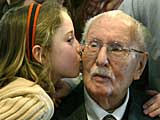
There are three Canadians left alive who served during the First World War. They are: 105-year-old Dwight (Percy) Wilson (shown in photo getting a kiss from his grand-daughter on his 105th birthday) and Lloyd Clemett and John Babcock, both 106. They are the last remaining links to the 619,636 Canadians who served between 1914 and 1918. Soon, when they too have passed on, there will be no one left to say, “Thank You” to from that terrible time in our history.

The Dominion Institute has suggested that when the inevitable day comes that the last of Canada’s WWI veterans passes, they should, on behalf of all the 66, 655 Canadians who died in service to their country during that war, be given a formal state funeral. I fully agree.

The passing of the last WWI veteran will, in fact, mark the passing of a generation, even an era. We should do all we can to make sure that their sacrifice does not fade from memory. To give the last veteran a state funeral as a significant tribute to every soldier who died in WWI is by all means a very fitting act. I hope you agree as well.

I am therefore asking you to join with me in asking our federal government to do just that. There is an online petition available to be signed at www.dominion.ca/petition . You may well have heard about this on the news by now, so what I have written here is not news. Some of you have already signed and for that I thank you. If you hadn’t please take a moment to click on the link above and do so. You will receive a verification email that requires you click another link to verify your email address is a valid one. The whole process takes only a few minutes.

The passing of the last Canadian WWI veteran will only happen once in our entire history. Let’s make sure it is an event that is well remembered.

Shalom…