Some thoughts on AI in Canada

I’ve been thinking about AI, like a lot of you, and I’ve come to a few conclusions.

1: It’s not going anywhere. It’s too powerful, too easy to use, and no amount of legislation is going to put this genie back in the bottle. So what does this mean?

2: If we don’t develop a plan, as a society, as a nation, and as a government, to develop and control how and by whom AI is used some other country will do it for us. Likely either the US or China. We’ve made that mistake before, we can’t afford to make it where AI is concerned.

3: Fear of AI is counter productive. The reason Canadians, including our policy makers, are so afraid of AI is because most of the tech bros that control or are trying to control AI are horrendous caricatures of Bond villains. Musk, for example. The ones who aren’t, aren’t in the public eye. We need to focus on them.

4: The thing is those same Bond villains will solve AI’s problems for the same reason they want to own AI to begin with – to make money. Cooling AI is expensive, figuring out how cool data centers efficiently, with as little water as possible, will cost less and thus improve profits. The same with energy usage, size of buildings, everything. Solving these issues will increase profits so they will solve them – eventually.

5: Therefore, the way to control AI is NOT to make it illegal. It’s to speed up that process by making it even more expensive. Make using water to cool data centers expensive enough to encourage R&D into using less but not enough to drive them out of the country. Same with energy, land, and everything else. Just banning it will not stop it. We’ve tried that before too.

Conclusion: As I said before, if we don’t have a plan for AI use and development one will be imposed upon us because trying to make it illegal simply won’t work. We need to make Canada a profitable place to invest in AI that makes doing in a responsible way the most profitable of all.

Before There Was Vinyl

Like many audiophiles I have appreciated the recent surge in the popularity of vinyl recordings. There is not only a marked difference in sound quality but there is also something satisfyingly tactile about placing the record on the platter and positioning the tonearm, triggering for yourself the moment the music begins. Putting an audio CD in the slot and watching the machine suck it in or tapping an icon on your phone just doesn’t have the same vibe.

That said, there is an even older format than vinyl that we are not very likely to see come back in the same way – beetle resin. That is to say – shellac.
That’s right – beetle resin. Shellac was used for a variety of things in it’s heyday from furniture and violin finishes, to fingernail polish, to electrical insulators, to..  well, records. If you have ever watched an old movie and seen someone break a record to stop it from being played again, it’s very likely it was a shellac disc because they were quite fragile and shattered quite nicely. Some of you will point out that vinyl breaks as well, and while that is true it just isn’t as easy to do as with shellac and in movie making you go with what works consistently.

The records ran at 78 rpm which is why you most often hear them referred to as 78s rather than “shellacs” and their fragility plus the fact they are made from beetle secretions is why you’re not likely so see this little piece of nostalgia on the shelves at Best Buy® any time soon. That doesn’t mean there is something wonderful happening with them however.

I recently became aware of The Great 78 Project, and effort by the Internet Archive, George Blood L.P., and The ARChive of Contemporary Music to preserve for posterity as many 78s as they can, physically and digitally.

The digitization work is being done by George Blood L.P., and will be made available to the public for download – FOR FREE! Great news for audiophiles and soundscape designers everywhere.

For the techies among my readers, I would like to point out that this is not easy because unlike their vinyl descendants, shellac records were not all created equal. Other than the fact they all rotated at 78 rpm (more or less) there were differences in manufacture from one publisher to the next, including diameter, groove size, spiral spacing, and shellac formula (some were softer than others so too heavy a tonearm might damage the groove). For the most part shellac records were designed to be played on the machines manufactured by the publisher of the music. They didn’t want you playing other company’s records on their machines and if you wanted you play their music you needed their machine. Kinda like Apple®.

As you can imagine this makes getting an accurate digitized copy challenging because it’s hard to tell exactly what the recording was supposed to sound like. George Blood met this challenge by, among other things, creating a turntable with four tonearms, each with a different size stylus. The full story on the digitization process can be found here.

The Great 78 Project is out to preserve as many 78 recordings as they can, not only sourcing them from artists and collections at various museums but they want your 78s as well. You can donate your old 78s to the project or they will advice you on the best way to digitize your collection and then you can upload the digital files to the project for inclusion.

Check it all out at The Great 78 Project.  @great78project


The Truth about Knowledge

“I think the Net generation is beginning to see knowledge in a way that is closer to the truth about knowledge — a truth we’ve long known but couldn’t instantiate. My generation, and the many generations before mine, have thought about knowledge as being the collected set of trusted content, typically expressed in libraries full of books. Our tradition has taken the trans-generational project of building this Library of Knowledge book by book as our God-given task as humans. Yet, for the coming generation, knowing looks less like capturing truths in books than engaging in never-settled networks of discussion and argument. That social activity — collaborative and contentious, often at the same time — is a more accurate reflection of our condition as imperfect social creatures trying to understand a world that is too big and too complex for even the biggest-headed expert.

“This new topology of knowledge reflects the topology of the Net. The Net (and especially the Web) is constructed quite literally out of links, each of which expresses some human interest. If I link to a site, it’s because I think it matters in some way, and I want it to matter that way to you. The result is a World Wide Web with billions of pages and probably trillions of links that is a direct reflection of what matters to us humans, for better or worse. The knowledge networks that live in this new ecosystem share in that property; they are built out of, and reflect, human interest. Like our collective interests, the Web and the knowledge that resides there is at odds and linked in conversation. That’s why the Internet, for all its weirdness, feels so familiar and comfortable to so many of us. And that’s the sense in which I think networked knowledge is more “natural.” ”

– “What the Internet Means for How We Think About the World” by Rebecca J. Rosen, January 5, 2012.

First published by The Atlantic.

via Google Reader.

Testing: One… Two… Three… Is this Thing On?

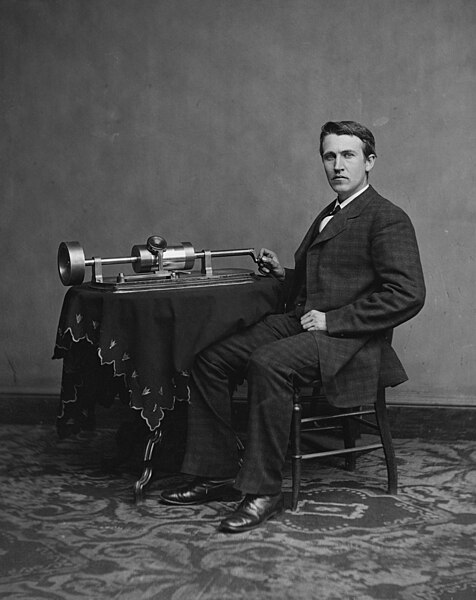
A great many things have happened on December 6th over the centuries, but for audio buffs the world over one event stands out above the rest. It was on this date in 1877 that the first audio recording was made by Thomas Edison. Previously, April 12th was considered to be the anniversary based on a date Edison wrote on a sketch of his device made in 1917; but subsequent research has revealed that Edison had misremembered the date and now many historians accept December 6th as the date of record. (pun intended)

Edison with phonograph (1877)

Edison with Phonograph in 1877. (Photograph by Matthew Brady - Courtesy Wikipedia Commons)

That first recording was made with the assistance of Charles Batchelor and John Kruesi. Working under the Edison’s direction they created the first phonograph consisting of a cylinder with a sheet of tinfoil wrapped around it.  Sound was received through a funnel, which was connected to a diaphragm. Yelling into the funnel caused sound waves to vibrate the diaphragm, which in turn vibrated a small stylus (needle) that was attached to it. The stylus pressed the pattern of the sound waves onto the tinfoil as the cylinder was turned by a hand crank.

The indented tinfoil sheet then was moved to another, nearly identical, device that had a stylus attached to the diaphragm with a delicate spring. As the hand crank was turned this time the stylus was passed over the indents on the tinfoil. The indentations caused the stylus and thus the diaphragm to vibrate in the same manner as when the original words were spoken. The vibrations of the diaphragm were amplified by another funnel and, if one listened closely, the recording was  heard.

Kreusi, who actually built the device from Edison’s sketches, is credited with the first review of an audio recording. His response? “Gott in Himmel!” (God in Heaven!)

The tricky part was turning the crank at the exact same speed as when recorded so the sounds could be recognized. Those early tinfoil recordings were quite fragile and could be played only a couple of times before they would become damaged and be lost forever. In later, more commercial models, wax and other materials would replace the tinfoil.

And what was that original recording you ask? It was Thomas Edison himself reciting the childhood classic “Mary Had a Little Lamb“. As already mentioned, those tinfoil recordings were fragile and the 1877 original is lost forever, but the following link will let you listen to a re-enactment made by Edison at the Golden Jubilee Celebration of the Phonograph made in 1927.

http://www.archive.org/details/EDIS-SCD-02

Today, 134 years later, quality recording technology is readily available to almost anyone. You probably have one in your pocket or purse right now. Few inventions have contributed to the shaping of culture and society world-wide as the ability to record and distribute the human voice.

In celebration of this world changing event I leave you with my favorite recording of “Mary Had a Little Lamb” by Stevie Ray Vaughn.

Give It a Second…

Came across this video today at The Long Now Foundation.  It is a great commentary of increasing impatience with technology.

I’ll be the first to admit I have an obsession with technology.  There is little that gives me more satisfaction than finding the right technology to simplify a task.  But as Louis CK points out, I think my fascination is born out of the fact that I remember when we had the dial phones. I remember my aunt who was on a party line and I had to wait until the neighbour was finished before I could make my call. I remember going to Malton Airport in Toronto for an afternoon to do nothing other than watch the planes come and go, amazed that something that big and heavy could actually fly.

Yeah. I know. I’m showing my age. But that’s okay. I’ve waited a long time to be this old and experienced and I’m going to relish every minute of it. So have a little patience, it wasn’t all that long ago the cell phone in your hand was the stuff of science fiction.
Till next time… give it a second!