Parallel Dimensions in the 19th Century

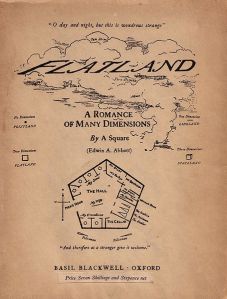
Flatland CoverIn 1884 Edwin Abbott Abbott (no – that’s not a typo; his middle name was the same as his surname) was headmaster of the City of London School (basically a boys school for poor children) and one of a number of Hulsean Lecturers at Cambridge University.  Like most theologian/lecturers of his day he had some success as a writer having published a textbook on Shakespearean grammar, a biography of Francis Bacon, a pair of religious romances (fictitious stories about Biblical characters), and an article on the Gospels for the 9th edition of Encyclopedia Britannica.

But it was in this year that Edwin Abbott would publish the work that would elevate him from theological footnote to one of the benchmarks in the history of the science fiction genre – a novella called Flatland: A Romance of Many Dimensions.

Now, before you get the idea that ol’ Dennis has gone all Harlequin® on you, a quick lesson in literary history. Originally the term ‘romance’ referred to a story of legendary proportions. They often referred to stories about the marvelous adventures of a chivalrous, heroic knight, often of super-human ability, who goes on a quest.  Toward the end of the 15th century French ‘romance’ novelists began to focus on the ‘rescuing young damsels’ notion that occasionally played a part in these epics and even began including extensive erotic narrations of the damsel’s gratitude. By the end of the 16th century the romance novel had fallen entirely out of favour in British society and the term was only used in a satirical manner.

And that is exactly how Abbott uses the term here; because, while the story of Flatland has been embraced by the science fiction community, when it was first published it was widely regarded as social satire due to it then obvious references to the general structure of Victorian society, taking on the severely limiting class structure and the deplorable status of women (unless you’re the Queen of course).

Flatland is the story of one Mr. A. Square, who is, by all accounts, a square. That is a geometric shape having four equal sides and four 90 degree corners living in a two-dimensional world consisting of a flat, never ending plane occupied a wide variety of other geometrical shapes such as lines (women- the rock bottom lowest level of Flatland society – animals get a better deal),  Isosceles triangles (lower-class workers and soldiers – men), Equilateral triangles (middle class workers – men), Squares (professional men – lower upper class), Pentagons, Hexagons and other Polygons (upper class professional men of importance proportional to the number of sides), and Circles (Priests – also men).

Mr. A. Square (varyingly called Arthur, Alfred or Albert in 20th century film adaptations) is a mathematician who is quite happy to spend his evenings exploring various geometric possibilities until one night he has a dream where he is taken to a one-dimensional world called Lineland and encounters its highly myopic monarch who quite literally can’t see anything that isn’t directly in front of him. The dream ends with Abbott’s protagonist failing to adequately communicate the reality of his two-dimensional universe.

Not long thereafter, during an otherwise routine night at home, A. Square is visited by Sphere, a being from Spaceland who endeavours to explain to our hero the reality of a three-dimensional existence. When words fail, Square is wrest from his own world and taken to Spaceland where he finally comes to terms with the reality of a world larger than his own.  The balance of the book covers Squares mission to spread the ‘Gospel of the Three Dimensions,’ or rather his failure to do so, and his subsequent…  well, I’ll let you read it for yourself.

The story has become a favorite of math teachers, theoretical physics professors and science fiction fans the world over, for its obvious ability to help its readers wrap thier heads around multi-dimensional thinking. It is also, as I mentioned, highly regarded as a critique on the unyielding class structure of Victorian society and especially on the status of women at that time.

But what is often missed completely, or summarily disregarded, is the fact that Edwin Abbott was, by profession and inclination, above all else, a theologian.  And it is in the pages of Flatland that Edwin endeavours to communicate his personnel theology, basically that miracles are all a matter of perspective.

When A. Square is first taken to Spaceland and sees the remarkable reality that is the 3rd dimension he worships at Sphere’s feet, okay not at his feet so much, he is a  floating sphere, but you get my drift.  His interplay with Sphere is very much a mirror of the common response of Biblical characters to the appearance of angelic beings. However, as he becomes increasingly accustomed to thinking in three dimensions, he imagines that if Flatland is one step above the single dimension of Lineland, and Spaceland is a step above Flatland, then it is only logical that there be a four dimension and a fifth and in the process of coming to this conclusion, Sphere seems less and less angelic and more simply a man like himself, only with a higher perspective on the order of the universe.  To his great surprise Sphere rejects this notion, insisting that Spaceland is the apex of dimensional reality. This is a very precise picture of Abbott’s personal theology.

You see, Abbott had a problem with miracles. It wasn’t that he didn’t believe Jesus performed miracles, he did. He just wasn’t so sure they were all that miraculous.  Edwin figured that while healing the sick, raising the dead and walking on water were decidedly remarkable things to be doing here on earth, he imagined that where Jesus came from they were probably pretty mundane, everyday tasks that simply needed doing.

He imagined that the difference between earth and heaven was likely a lot like the difference between the two-dimensional Flatland and Spaceland in glorious 3D. The concept of ‘height’ transended Square’s 2D world and has all the trappings of the miraculous until he actually visited Spaceland, and once he became accustomed to it the glory of it all paled somewhat.

Many passages in scripture talk about how God’s ways are not our ways and how our feeble little brains would have trouble conceiving of it all.  Numerous scholars over the centuries have pointed out that the visions the prophets had were hard to discern because of the gap that exists between the earth and the heavenlies. Edwin simply wondered if we would feel the same way if we had oppurtunity to spend time in the heavenly dimension. Would our new awareness change our perseption of the seemingly miraculous.

Not a bad question in and of itself, but where Abbott got into trouble (and believe me he did) was in the fact that the interchange between Sphere and Square seemed to imply that there may be another dimensional reality above the one that Jesus came from. That God might have a god above him!  This of course was widely regarded as heresy despite Abbott’s contention that he really hadn’t meant at all.

But the angle I’m driving at (pun intended – read the book) is not about the validity of Abbott’s theology, but that science fiction, rather than being the enemy of theology has often been used to help people understand it, even to promote it. Flatland is a good example of just such a case. Learning to think in multiple dimensions is, I believe, of great benefit when trying to understand the realm of God and how it can differ from ours so much as to seem beyond comprehension.  Many people have a hard time understanding God in the same way that the two-dimensional A. Square had a hard time comprehending of the concept of height until he was given a ‘supernatural’ experience of it.

There’s more that could be said about Flatland, but it would be better understood if you’ve read the book, so I’ll stop here. Feel free to continue the conversation in the comments section. I’ll happily respond.

Flatland: A Romance of Many Dimensions. can be read online complete with the original illustrations at Google Books.

There are a few movie adaptations to be found a IMDb.

Until next time…  Shalom.

Les Voyages Extraordinaires

If Mary Shelley gave birth to the science fiction genre, then Jules Verne is the father that took it on Sunday outings to the country… and to Africa, to the centre of the earth, to the moon, and to a host of other remarkable places.  He was also a scientific author and visionary who predicted, among other things, submarines, helicopters, skyscrapers, space exploration and the use of hydrogen as a major energy source.

Born in the port city of Nantes, France in 1828, Jules Verne was obviously inspired to travel and explore by the many schooners and other ships that frequented the local harbour. Like his father, Verne trained to be a lawyer and obtained his degree at the age of 22, but rather than writing dissertations Jules preferred to write short stories, plays, poems, and operettas on which he collaborated with his good friend and musician Jean Louis Aristide Hignard enjoying some small measure of success.

When it came to novels however, Verne had a hard time getting published. This was largely due to a somewhat pessimistic view of the world he held at the time which inevitably showed in his writing.  Fortunately for him, and science fiction readers everywhere, he developed a relationship with publisher Pierre Jules Hetzel who took him under his wing and helped him to realize that people preferred happy endings and humour in their casual reading. Verne readily took his new friend’s advice and rewrote a number of stories which Hetzel published as the lavishly illustrated “extraordinary adventures” series.

The series began with Five Weeks in a Balloon (1863) – the adventures of an English explorer who, with his servant and best friend, attempts to traverse Africa in an inovative design of balloon; Journey to the Center of the Earth (1864) – the account of a German professor’s attempt to retrace the steps of a previous explorer who claims to have visited the centre of the earth; and From the Earth to the Moon (1865) the highly detailed story of the attempt by members of Boston’s infamous ‘Gun Club’ to fire a projectile at the moon carrying three adventurers, which inspired Verne to introduce to the genre what would become another great science-fiction mainstay – the sequel – All Around the Moon (1870).  Verne’s stories were largely well received in France and other European countries (after extensive assistance from Hetzel –  listen to your publishers people) but were not as readily received by the English-speaking markets. In general there are two reasons given for this.

More often than not, among the travellers in Les Voyages Extraordinaires, you will find an individual whose vocation or class in society deprived them of sufficient education to fully understand either the science and/or the history of what is transpiring around them. When this happens Verne’s protagonists (Dr. Samuel Ferguson, Professor Otto Lindenbrock and Gun Club president Impey Barbicane, in the case of the aforementioned titles) would be more than happy to provide the required exposition. These expositions covered a variety of subjects from the lifting properties of hydrogen to the need for America’s lunar exploration efforts to be launched from the Florida peninsula.  By the use of this literary device it could truly be said that Jules Verne put the ‘science’ in science-fiction; however, British publishers, unlike their European counterparts, found these expositions exeedingly dull and since they didn’t see any benefit in educating their readers along with entertaining them, edited such passages out of the English translations of Verne’s work, taking entire chapters along with them.

The second reason was akin to the first in that British publishers also thought Verne painted the English in a bad light and did not entirely appreciate his characters’ tendency to form friendships across class and racial boundaries. Again, these offending passages were heavily edited in the English translations and as a result many, especially in North America, considered Verne to be highly racist and anti-Semitic.  Even today scholars continue in their efforts to reveal the authentic Jules Verne that the world may truly appreciate his extraordinary vision.

One thing that did survive translation though are a number of indications that Jules Verne was, in all likelihood, a man of faith; which brings us back to the subject of this series of posts. Consider for a moment these three passages from Les Voyages Extraordinaires.

“My God! my God!” exclaimed the dying apostle, “have pity on me!”

His countenance shone. Far above that earth on which he had known no joys; in the midst of that night which sent to him its softest radiance; on the way to that heaven toward which he uplifted his spirit, as though in a miraculous assumption, he seemed already to live and breathe in the new existence.

His last gesture was a supreme blessing on his new friends of only one day. Then he fell back into the arms of Kennedy, whose countenance was bathed in hot tears.

“Dead!” said the doctor, bending over him, “dead!” And with one common accord, the three friends knelt together in silent prayer. [1]

Lost at an immeasurable depth! Thirty leagues of rock seemed to weigh upon my shoulders with a dreadful pressure. I felt crushed…
… When I saw myself thus far removed from all earthly help I had recourse to heavenly succour. The remembrance of my childhood, the recollection of my mother, whom I had only known in my tender early years, came back to me, and I knelt in prayer imploring for the Divine help of which I was so little worthy.
This return of trust in God’s providence allayed the turbulence of my fears, and I was enabled to concentrate upon my situation all the force of my intelligence. [2]

“Ardan, dear friend,” interrupted Barbican, in a grave tone, “a serious
moment is now at hand. Let us meet it with some interior recollection.
Give me your hands, my dear friends.”

“Certainly,” said Ardan, with tears in his voice, and already at the
other extreme of his apparent levity.

The three brave men united in one last, silent, but warm and impulsively
affectionate pressure.

“And now, great God, our Creator, protect us! In Thee we trust!” prayed
Barbican, the others joining him with folded hands and bowed heads. [3]

I would like to point out at this juncture that I have watched film versions of all these novels and can attest to the fact that not one of these three scenes appears in any of them! Which leads me the first of my general assertions:

1 – It is not science-fiction that has a problem with God and spirituality,  but rather Hollywood.

Throughout all of Jules Verne’s writing there a numerous references to God and to spirituality in a number of various contexts. At no point is it presented as a blatant evangelical outreach, as so often happens in Christian literature, but rather as simply the natural inclination of the characters in the story. But for some reason, in all the cinematic renditions of these novels that I have seen anyway, that inclination is either removed completely or reduced to a single token acknowledgement of the attitudes of the era in which the story is taking place. Which brings me to my second assertion:

2 – Many of science-fiction’s most vocal critics are likely basing their opinions upon what they observe on movie and television screens and not on the pages of the original literature.

Let’s face it, all of us have at one point or another been disappointed at the results when our favorite book has been made into a movie.  Movies have a variety of constraints placed upon them which literature need not adhere to; the greatest of which being, to quote Alfred Hitchcock, “The length of a film should be directly related to the endurance of the human bladder.” As a result scenes are cut, dialogue shortened and simplified, and narration all but eliminated.

In addition, while a good book can make a living for it’s author with a relatively narrow audience, a film, no matter how good, often needs a much wider market. For this reason elements are often added to widen a story’s appeal. For example, to increase the audience of Journey to the Centre of the Earth the 1959 film adds two characters into the mix that do not appear in Verne’s original story; the widow of a rival professor to add sexual tension and antagonize Lindenbrook along the journey, and a distant relative of Arne Saknussemm’s who is bent on creating an underground empire for himself.  Now I’ll admit, I loved the film – a lot, have seen it many time (so many that as I reread the novel for this post I had a hard time not hearing the voice of James Mason in my head); but if you are intending to evaluate the spiritual value of Verne’s writing by watching the movie, you will be severely ill-informed, and I strongly suspect this is often the case among many of science-fiction’s critics.

Ferguson's ballon is towed along by an elephant

Image curtesy Arthur B. Evans

As we continue this journey through my memories of a life reading science-fiction, I hope to provide additional evidence to back up these assertions, along with others I shall make along the way. But for now I think I’ll leave things as they are. There is however, one thing more.

In All Around the Moon, there are a few statements made that relate not only to the science-fiction debate but the the larger debate of science vs faith that is so much a part of modern media debate. However, this post is already long enough and to try and deal with the topic here would hardly do it justice. There is also the fact that I would like to include additional resources before I delve into the subject so it will have to wait for another time.

I mention this because I am certain some of you will, upon reading the story for yourselves, make note of the statements and wonder why I did not include them in this post. Well, now you know. Trust me, they are not overlooked.

Until next time then…  Shalom.

  • Many of the works of Jules Verne can be read online at The Literature Network
  • Some of the lavish illustrations that appeared in the original publications can be viewed HERE.

—-

[1] Five weeks in a Balloon, Chapter Twenty-Third, http://www.online-literature.com/verne/five-weeks-in-a-balloon/23/

[2] Journey to the Center of the Earth, Chapter 27, http://www.online-literature.com/verne/journey_center_earth/27/

[3] All Around the Moon, Chapter 1, http://www.online-literature.com/verne/around-the-moon/1/

Back to Where it All Began.

Over much of Europe 1816 was known as “The Year Without Summer.” Thanks to the ash cloud that hung over the continent due to the eruption of Mount Tambora the year before, the weather was far too cold and dreary for anyone to justify using the season’s traditional designation. At the villa of Lord Byron on Lake Geneva, Switzerland; Mary Wollenstone Goodwin,  Percy Bysshe Shelley, Clair Clairmont, John William Polidor and their esteemed host were spending just such an inclement evening reading German ghost stories and discussing all manner of subjects from vegetarianism to the possibility of re-animating the dead. The story goes that at one point in the evening Lord Byron suggested that each of them should write their own supernatural tale.

Such a challenge would not have phased the likes of Shelley and Polidor who, like Byron, were already established writers, but for the 18-year-old Mary Goodwin I’m sure it was a bit more daunting. She set down to write a short story in which she considered how frightful it would be for “any human endeavour to mock the stupendous mechanism of the Creator of the world.”[1]  Shelley, her lover whom she would marry later that year, encouraged her to expand the tale into a full novel. She finished it in November of 1817, and on January 1st, 1818 the world was introduced to Mary Shelley’s Frankenstein.

And in that same story, according to many, the 19-year-old daughter of a political philosopher and his feminist wife also gave birth to the genre of Science Fiction.

By the time I read Mary Shelley’s Frankenstein in my early twenties science fiction was already established as my genre of choice. With my parents encouragement I grew up reading Jules Vern, Robert Heinlein, Issac Asimov, E.E.’Doc’ Smith and a dozen others. In 1969 I sat glued to my TV set watching Neil Armstrong walk on the moon and thought to myself, “Wow, it’s all coming true.”

Frankenstein was large in my mind as well, but only the Frankenstein of the movies. Boris Karloff brought the monster to life for me; terrifying and terrified, he met a fiery end at the hands of frightened villagers.  The monster was reincarnated as the companion of Dracula, the Werewolf, and many others including Abbott and Costello. So it was a great surprise to me when I read the novel that started it all because, as I was soon to discover happened all too often, Hollywood didn’t appear to have read the same book as I did.  In Mary’s story there is no Igor, no villagers with pitch forks, no apparatus to capture the power of lightning, and while Castle Frankenstein in Germany may have played a role in inspiring the name of Mary’s protagonist, the castle itself appears nowhere in the story.

Mary’s story is, in fact, an epistolary novel, told in the form of a series of letters between one Captain Robert Walton and his sister Margaret. He recounts the series of events that lead to his exploration of the Arctic in an effort to reach the North Pole. Before he achieves his goal however, his crew spot a giant form, human in appearance but impossibly large, travelling across the pack ice on a dog sled. A day later they rescue Victor Frankenstein, nearly dead from exposure, whose own dog sled has succumbed to the treacherous terrain leaving him pursuing the creature paddling an ice raft. Walton then recounts to his sister the incredible tale that Frankenstein relates during his convalescence on board ship. The story of one man’s attempt to create life from non-life, and the terrible consequences of his success.

And therein lies the core of Mary’s tale. The story was originally published under the title Frankenstein; or, The Modern Prometheus. It is an apt sub-title. The Prometheus myth comes in two flavours; in Latin Prometheus is the one who creates mankind out of clay and water, while in Greek he is the Titan (half god/half human) who steals fire from the mountain of the gods and gives it to mankind so that they might become greater than what they are. In both versions Prometheus is punished for what he has done.

So it is with Victor. He starts out, innocently enough, as a man bent on learning all that he can about death in order to defeat it. Driven by his grief at the loss of his mother he studies every aspect of the body’s decay and, by applying what he has learned in the field of chemistry and other sciences, discovers a method for animating unliving flesh. As the crowning touch to his research he sets out to make himself a man, which he does, assembling the creature from various sources including both “the dissecting room and the slaughter-house.” The creature is made larger than a normal human because of, as Victor puts it, “the difficulty in replicating the minute parts of the human body.” All of this work is done not in some remote castle in the dark woods of Transylvania, but in his assigned lab at the university in Ingolstadt.

But then something happens the reader does not expect (I told you I wouldn’t avoid spoilers). When he finally does succeed in imparting life to his creation (exactly how Frankenstein does not reveal to Walton), there is no moment of joy, no victorious cry of  “It’s alive!” at the top of his lungs. Instead there is only fear and revulsion at the sight of the hideous monster that now stands and breathes before him. He flees, leaving the creature alone in his room as he runs out into the street, overwhelmed by the horror of what he has done.

Here then is where Victor departs not just from the room, but from his role as creator. Unlike the God he aspires to equal, Victor takes no responsibility for his creation. He does not build a garden for the naked creature to live in nor embrace his creation as a loving father would. He doesn’t even hang around long enough to give him a name! Instead, like Adam in the garden after the tree incident he seeks to hide himself from his sin.

Victor goes home because the guilt he feels at his actions causes him to succumb to a substantial illness. Meanwhile the creature flees the city as well and living in the woods, subsists on berries and other vegetation (Mary was a vegetarian), and observing mankind from a distance he eventually decides to seek out his creator. When he does, we are surprised to learn that the creature has mastered not only the ability to speak but to read, and makes quite an eloquent argument to his creator of his need for acceptance, family, and for love.

Victor at first is moved by the creature’s intelligence, deep pain of loneliness but still refuses to take responsibility for the life he has created, refusing to fulfill the creature’s desire for a mate, an Eve to his Adam if you will. Because of Victor’s continued rejection the creature seeks revenge and begins a killing spree that leaves Frankenstein without friends or family denying his creator any hope of experiencing the love he refuses to bestow upon the life he brought into the world.

Exactly how the story ends I will leave for you to discover should you decide to read it.

——

I can hear some of you saying, “Okay Dennis, but what about the spiritual side? What about the questions you asked in the previous post?”

Well, it appears that rather than being anti-God, amoral, or mired in the triumph of science over faith, science fiction has its genesis in the story of a man who infringed on God’s domain and suffered for doing so. For all his vaunted declarations of the supremacy of knowledge and the wonders of chemistry, Victor Frankenstein could not meet the responsibility of creating life. He himself recognized his creature as an abomination and realized the only thing he could do to make things right was destroy it, pursuing it to the ends of the earth, literally, in an effort to correct his mistake.

Shelley’s story reminds me of the Tower of Babel. In Genesis 11 we are told that God separated the people by language because they had gotten too arrogant in their faith in their own abilities. He feared for what they might try to do next; and this just for building a skyscraper!  In Frankenstein Shelley fears that mankind’s pursuit of knowledge is headed in a far more dangerous direction and through her tale seeks to issue a warning.

The Frankenstein Argument is still a valid one today; and one that I subscribe to,  both as a Christian and as a fan of technology. Humanity has not yet succeeded in animating unliving flesh in the manner of young Victor, but through the use of various biotechnologies we are trying to improve on God’s design. The motivation is the same as Victor’s, end human suffering and make us more resilient to disease and injury, but the consequences of success could be equally tragic.

There are plenty of other themes that could be discussed in relation to this story. Loneliness and the need for companionship is a big one. Dysfunctional families, deadbeat dads, judging people by their appearances; it’s a lengthy list and if you’d like to explore some of these issues, as they relate to Frankenstein, I’d be happy to do so in the comments.

But for now, I would have to say – yes gentle reader, Mary Shelley has contributed to my world view. But contrary to the contentions of the critics, she has actually reenforced my Biblical perspective.  Shelley lived a hundred years before Joyce Kilmer, but it would seem she agreed that “only God can make a tree” or a man.

Till next Time…  Shalom.

• Mary Shelley’s Frankenstein can be read online at Project Gutenberg.

• For a movie version that holds to the original story (for the most part) see this excellent production by director Kenneth Branagh

———

[1] Quoted from Mary Shelley’s introduction to the 1831 edition of Frankenstein.

Read Science Fiction – Go To Hell!

I received a Tweet the other day with a link to this article from a follower who calls into question anything I read that was written by people younger than A.W. Tozer. Okay, a bit of an exageration; but the fact remains he considers every moment I spend reading science-fiction or fantasy as a moment not spent reading the Bible and therefore – a sin.

I read the article and found the usual list of objections; SF is based on science not faith, SF authors are mostly athiests, SF promotes evolution and, my personal favorite, science fiction “presents a distorted view of reality.” Imagine that, a fictional work that doesn’t reflect reality? Go figure!

The article did however, get me thinking about the science fiction and fantasy I have read over the years. I sat down and started putting a list together and came up with nearly a thousand titles when the data stream ran dry. (I know there’s a bunch more, I just couldn’t recall them as I was making the list.)

The one thing I noticed as I ran through the titles is that a great many of them actually deal with the subject of God, religion and spiritually, and not always in the negative.  In fact, as I recall the ones that did try to oppose the notion of God actually had some of the best things to say on the subject; or at least, that’s the way I remember it.

And hence the motivation for this post, and likely a bunch more to follow.  Exactly how has the science fiction and fantasy I’ve read over the years helped to shape my Christian world view; if at all? Has it been good or bad?  Also, is there a running theme of spirituality in science fiction?  A quick Google on the subject would suggest yes, but I’ve decided to explore my own choices, along with the opinions of others.

List in hand I intend to reread a fair number of the titles that stand out most in my memory and examine what they do or do not have to say about God, religion, and spiritually, and try to discern if they had any role in shaping my world view.  I can’t remember the order I read them in so I’ve  decided to read them in the order in which they were written and then comment here.

Please keep in mind that these will not be reviews! I’m not trying to tell you if a particular book is a good or a bad one, or whether you should read it or not. (Though that might come up.) The goal will be to discuss each work from my own spiritual perspective and see what surfaces. It will be largely a self-examining exercise on which you are invited to eavesdrop.  Little or no effort will be made to avoid spoilers, giving away the ending, or revealing the secret twist in the plot if discussing it is germain to the conversation. I will try to remember to warn you if a spoiler is coming, but I make no promises, so don’t cry the blues if I forget. Like I said, these aren’t intended to be reviews, so please regard them as such.

Anyway… that’s what’s to follow – read or don’t read;  agree or disagree; comment at will. The first article in this series will be posted tomorrow. Till then…

Shalom.