15 Instead of 55

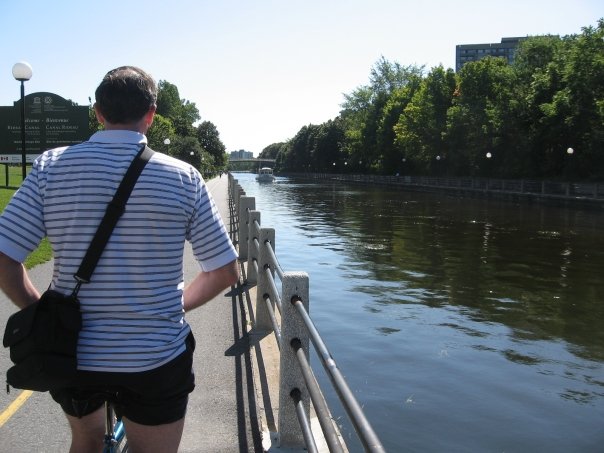
Steve along The Rideau Canal

Steve along The Rideau Canal

I spent this past weekend in Ottawa visiting with my brother Steven and his family. It was a great time and reminded me once again why I love cycling so much.

Bicycle paths and bike lanes criss-cross the entire Ottawa-Carleton region. It is one of the best places to go cycling in all of Ontario. For me the best trails are the ones along the Ottawa River, partly paved, partly gravel, fully treed, the river on one side, urban forest on the other, dotted with history for much of the journey it is simply a great ride.

We took our bikes downtown on the bus (I like their racks a little better than the ones Guelph has just added) and then rode from the university along the canal, looped around Parliament Hill, and then followed the river back to Steve’s place in Orleans. Along we way we watched boats of all kinds sail up and down the Ottawa River, watched biplanes takeoff and land at the Aviation Museum, checked out the horses that perform in the Musical Ride at the RCMP stables, and enjoyed ice cream and frozen yogurt at Rockcliffe Park.

I was using my nephew Bryan’s mountain bike so it was a little small, and a little slow at times, but it didn’t take long for the joy of the ride to settle in and fade the size of the bike into the background. I can’t really nail it down to one specific thing but there is just something about riding a bike that speaks to the kid in me. After a few clicks the creaks and groans of middle-age fade and the teenager re-emerges. The sun, the wind, the freedom – the only words I’ve found for it are in the title of this post – ” I feel 15 instead of 55.”

And with the summer we’ve had I really needed a dose of 15-yer old exuberance. It took till Labour Day Weekend but Saturday felt so much like summer.  No rain, warm breezes, bright sunshine… I wanted it to go on forever. We rode for over 30 km and only had to deal with car traffic about 10% of the way. The rest of the ride was trails designed and installed specifically for cyclists, skateboarders, inline skaters and pedestrians.  It was a great day that I will remember for a very long time.

But it doesn’t have to be a once a year thing. My brother enjoys this commute 2 ot 3 times a week. He has this privilege because the infrastructure in Ottawa has been fashioned with all the road users in mind.  Other cities could easily do this if they had a mind to.  Some, including Guelph, claim they do. They look to Europe and Copenhagen to find the example they need for infrastructure and cycling culture. But they don’t need to look that far away, it exists right in their own back yard.

Is Ottawa a cycling paradise? Hardly! It suffers from all the same conflicts between drivers and cyclists that exist elsewhere.  In many places the two factions continue to get in each other’s way as driver fail to look for bicycles and cyclists behave like the rules of the road don’t apply to them. But Ottawa has gone a long way to keeping the warring factions apart.  Seperated bike lanes and trails make far more sense than adding bike lanes to the busiest streets in our cities. That is just asking for trouble.

But most of all the Ottawa example dispels the myth propagated in Southern Ontario that Canadian climate makes cycling an impractical solution for environment, infrastructure and a healthier population. No one can claim that Ottawa has mild winters or a short season. It simply takes commitment and patience.

It will take time to make the shift from a car centred culture to one of shared roads and services, but when it does happen then maybe instead of road rage a fewmore of us will spend the commute recapturing a little of our childhood.

Here’s the route we took:  Bikemap Route

My Facebook album of the ride:  Ottawa Album

We Will Return to our Regular Programming…

I’m spending this week tracking down all the places on Kortright’s website where Don McCallum’s name appears as a contact. I will admit it is a weird feeling. It’s also an interesting little dance trying to figure out where to draw the line.  It’s going to be a bit of a dance for a while I’m sure, but eventually it will all get worked out.

One of the interesting aspects of this is how to refer to Rev. Ralph Neil. Ralph has agreed to take on the bulk of the Sunday morning teaching duties for the duration of the interim process. With a few decades experience under his belt in both the Baptist and Presbyterian denominations he’s an excellent choice and we are blessed to have him and his wife Bonnie around.

He’s a great guy and a good preacher, but what do I call him? He’s not the pastor, he’s just the person who will be preaching on Sunday mornings.  And while he is an ordained minister, to call him the minister also has connotations of permanence that are likely best avoided. I’ve settled on the title ‘Interim Speaker’ based on some input from members of session and a learned friend of mine. And while it works for reference purposes, it too is a less than perfect choice.

The word ‘interim’ seems to hold different connotations for different people. This is best illustrated by something I overheard during the picnic lunch after Don’s last service.  One person in the line up for coffee said to another, “I hope the process of finding a new pastor doesn’t take too long. Once this interim period is over we’ll be able to get back to normal.”

Now, while I agree with the sentiment that the process should not drag on too long (personally I’d like to see us with a new pastor in time for our 30th anniversary in Sept 2010) I really hope we never have to “get back to normal” because I don’t want to see us leave normal in the first place. The ‘interim’ is not about abandoning normal for the next year or so and then getting ‘back to normal’ later on.  At least, I don’t think it should be.

Because the ‘normal’ operation of the church is not dependent on who the pastor may or may not be.    The normal operation of the church is to love God, love others, care for the poor and the sick, comfort the heart-broken, lift the downtrodden, and proclaiming the good news to the nations. This is not of course an exhaustive list, but you get the idea.  These activities should make up the normal daily life of the church and should be continuing to take place regardless of who’s preaching, who’s on session, or who’s making the coffee between services.

This, for me, is the challenge of the next few months, not putting church life on hold until the search process is over. The pastor is just another member of the congregation, a significant member to be sure; a member with great responsibility without question; but in the end, still a member of the congregation along with the rest of us. And it is the congregation that determines what ‘normal’ is in the life of the church.

The period Kortright is facing is not like summer reruns on television and when the new ‘host’ is hired we will “return to our regular programming.” The months to come are integral part of the life of the church. It is, if you’ll excuse an entirely over-worn expression, our ‘new normal.’ It’s part of the process that God is taking us through to make who He needs us to be to bring about His kingdom here on earth.

The pastor can and should be used by God to influence that process; he or she can show us from the Word what God expects normal to look like. But ultimately it is the congregation who, by their actions and testimony as they live their lives before the world, determines what is the day-to-day normal of the church. And they need to keep doing that regardless of who is occupying the pulpit, either permanently, or just for the interim.

Hanging in for the duration… Shalom.

The End of an Era.. of sorts.

Well… it’s done.

Pastor Don McCallum has preached his last service at Kortright Presbyterian Church. After 18 years he and his family have about a month to complete moving exercises and then he will be a part of Knox Presbyterian Church in Listowel.

It was a good service. There were songs (including one specifically written for the occasion – a copy to be posted later this week), and videos, and memories, and the presentation of gifts ( a book of memories and a bicycle – highly appropriate). But most importantly, there was release.

It’s the hardest part of change – letting go of the past. Allowing those who wish to move on to do so.  As a species humans do not generally welcome change, we would much prefer to surround ourselves with the familiar and the security provided by knowing exactly what to expect each day.

And yet, without change there is no growth, and I have come to realize that Kortright has come as far as Pastor Don is/was able to take it.   He came to KPC at a time when much healing was required and he guided them through that healing. He held their hands as they took their first steps into becoming an adult congregation. He has done his job well.

But the complexion of Kortright is changing. New people are arriving each month (we’re back up to the number we had before the move) and there is a different expectation now of what the future might hold. It is time for Kortright to leave home and set out on it’s own- so to speak.

Congregations are not teenagers, however.  It would be rather impractical for the entire congregation to move out of 55 Devere Drive and seek out new adventures, leaving Pastor Don and the building behind awaiting the arrival of a new flock. (Interesting concept though, might be a skit there)  So, as practicality dictates, it is the pastor who moves on.

Moves on to face new challenges of his own as the congregation he leaves behind begins the process of figuring out who we are and who we want to be. A process we have already begun. But an era has ended, the McCallum Years are complete.  Now only God knows what the future holds for either of us.

I eagerly await the arrival of the new era.

Thank you, Kwai Chang Caine

This may sound a little strange to some of you, but I am truly saddened by the passing of David Carradine.  No, I’m not morning the lost of a great action figure like some, nor did I think of him as a role model the way he is being portrayed by others.  And yet, truth be told, without him my life might have taken a very different turn.

I was 18 when Kung Fu came to television. Carradine’s charater Kwai Chang Caine fasinated me. The juxtaposition of passive demeaner and explosions of violence was something I had never considered.

At the time I was part of a Christian High school group; I didn’t really believe, I was just madly in lust with one of the female members of the group.  Kwai Chang Caine however, caused me to seriously examine the question of spirituality.  I sought out instruction in Eastern philosophy and eventually wound up learning from a Buddist instructor at the same time that I was attending a Baptist congregation.  He often commented on the teachings of Jesus and thought that the Jewish rabbi must have been exposed to Buddist teachings at some point.

His take on Jesus’ teaching was, however, somewhat different from what I was learning in the Baptist church. When I would tell him what my pastor had told me a passage meant he would often respond with, “Really? But that’s not what He said.” It was this exposure to non-Christian examination of scripture that caused me to take a serious personal look at the Bible rather than just accepting what I was told it meant.

Eventually both the girl and the Buddist moved out of my life – but Jesus remained. And so did a desire to fully understand the context of what Jesus was saying.  All of which has, of course, contributed to who I am today.

Even though he played a relatively small role in my spiritual development, I followed Carradines career with more than a passing intertest. It is said, “A journey of a thousand miles begins with a single step” and Kwai Chang Caine was the motivation for that first step. And so I find myself feeling a small measure of indebtedness to the character and the  actor.

When I learned of his death however, it was not any of the King Fu scenes that came to mind.  (No I don’t buy the suicide angle, neither do I think the asian Mafia had him killed.) No, my favorite Carradine moment will always be the Superman speech from Kill Bill 2. It’s a great commentary on the nature of masks and identity.  I think it stuck in my mind because of the fact that Superman is one of the most widely distributed archetypes of Christ, which puts an interesting slant on the commentary.

(For the more sensitive among you – brief bad language advisory.)

Towards Cycling Culture

As I make my way down the final stretch to the Ride to Conquer Cancer, I find myself pondering the move towards cycle culture in North America and why it isn’t more like Europe?

For the last year or so I’ve been following a blog called Copenhagenize.  Written by an ex-Calgarian now living in Copenhagen, it and it’s sister site Copenhagen Cycle Chic chronicle how Danish cycle-culture is progressing and Copenhagen in particular should be the model the rest of the world uses to shape cycling infrastructure in the big cities. To be fair, there’s a great deal I like about what Mikael has to say, and I certainly would like to see Canada follow more of the Danish example when it comes to cycling infrastructure; separated bike lanes, extensive bicycle parking at malls and public buildings, elimination of helmet laws, etc.  But there is one major difference between Europe and North America that will likely always stand in the way.

Europe moves at a much slower pace.

It’s a mindset thing. Throughout most of Europe things happen when they happen. Deadlines are largely regarded as suggestions, stress relief often involves coffee in a street cafe in the middle of the afternoon, shops will even close in the middle of the day to take in a soccer game or a concert.  The trip to the shop or office is as much an experience as being there.

Not so in North America.  Here it’s all about getting as much done as possible in as short a time as possible.  Fulfillment is found not in relishing every moment of an experience but rather in cramming as many experiences into the moment as possible.  North America has always had a quantity over quality mindset. The daily commute, the trip to the store is a means to an end and nothing more. We get from A to B is as few steps as Google Maps can lay out for us and it better not take one second longer than the estimate.

Even what passes for cycling culture reflects this.   The mainstay of the European bicycle commute is the city-bike.  Ridden by men and women alike it allows one to travel in style; long coats, skirts, pumps and even stilettos are suitable cycling fashion. For families, the bakfeit or cargo bike allows mom or dad to ferry the kids around in safety without ever having to take the eyes of the hope of the future.

In North America however, it’s all Spandex and helmets, 27 speeds and razor thin tires, beat the rush and get to the office in time to grab a shower and wash away the record setting attempt at getting to work.  Kids interrupt air-flow so tuck ’em in back or park ’em in a trailer out of sight so we can focus on the road ahead.  Slow bikes are as much an annoyance as slow drivers and cycle chic is measured in Day-Glo jerseys and the latest high-tech shoe clips.

As long as this is the case I’m afraid that cycling culture in Canada will always be at war with the cars.  Bicycles don’t mesh with North Americas high speed lifestyle. It’s hard to embrace the bicycle when you want to be everywhere 10 minutes before you left and want to take half the house with you in case you need something.

Slow Bike Movement

Slow Bike Movement

If North America is ever going to move towards a vibrant effective bicycle culture the first thing it needs to do is slow down. Not just on the roads but in the way we approach life itself.

“Slow down, you move too fast.
You got to make the morning last.”

See you in Niagara Falls —