Beware the Ides of March

“Beware the Ides of March”

This past Sunday was the 15th of March. As expected, my various social media feeds were inundated with Ides of March memes, some good, some not so good, some downright vicious. But they all got me thinking about betrayal, and not surprisingly I wound up going down a bit of an Ides of March rabbit hole. It’s now Thursday, and in an attempt to bring some closer to this exercise I’d like to share a few thoughts with you.

For the three of you out there who aren’t familiar in the phrase, if you were a citizen of Rome in the heyday of the Roman empire, the ‘ides’ was a fairly important day for you. The Romans didn’t number the days like we do; they relied on the various phases of the moon and counted forward or back from there. The ides marked the appearance of the full moon, regarded as the middle of the month, falling on the 15th in March, May, July, and October, and on the 13th the rest of the year. These days were dedicated to the worship of Jupiter, and the Ides of March, being the first full moon of the new year, held a great deal of spiritual, social, and even economic importance, not only being a sacred day for the worship of Jupiter, but also the annual feast of the goddess of the year – Anna Peranna, and the day on which rents were paid and debts were traditionally settled.

For us March 15th has become synonymous with misfortune and betrayal due to events which culminated in the assassination of Julius Ceasar by numerous members of the Roman Senate on that date in 44 B.C. It’s an event which would likely only be a footnote in history if it weren’t for William Shakespear, whose play “Julius Ceasar” was first performed 1,642 years later in 1599.

In that play the phrase “Beware the Ides of March” entered into popular culture along with “Et tu, Brute!” (You too, Brutus?) as Ceasar’s best friend joined the others in stabbing him twenty-three times. Historians aren’t sure these were actually Julius Ceasar’s last words, or if he said something else entirely, or even anything at all. Never-the-less it has become what is likely the second most famous act of betrayal in history.

Why did they kill him? Well for a number of reasons, but mostly they were fed up with the crazy things he kept doing, many of which seemed completely out to lunch, but listing them here would be a rabbit hole I’m going to avoid. However, one of their complaints has ramifications even today.

Julius Caesar’s support for the Jewish people is well-documented, primarily through the writings of the 1st-century historian Flavius Josephus, who recorded numerous decrees and letters issued by Caesar and the Roman Senate in 47–44 B.C. Among other things they were allowed to worship their own god, and had their own king, even if he was mostly a Roman puppet. These measures were largely a reward for the crucial military aid provided by Jewish forces, led by Antipater and supported by High Priest Hyrcanus II, during Caesar’s siege in Alexandria. 

Many grew to resent the Jews because of their special status and the fact that they refused to assimilate into Roman culture; not eating pork, not celebrating Roman holidays (such as the feast of Anna Peranna), and refusing to worship the emperor along with their own god. Some even suggest that this might be where the global Jewish conspiracy theories had their start, since they had it so good, they must have paid Ceasar for these privileges, etc. etc. etc.

Which brings me to Lent (really, stay with me a moment).

It has always been of some note to me that the Ides of March usually falls within Lent, the 40-day period leading up to Easter, during which much of the world remembers and contemplates the most famous act of betrayal in history, that of Jesus of Nazareth by one Judas Iscariot. I know, the purpose of Lent is to contemplate Jesus’ death and resurrection and what this means spiritually for all mankind, but can you really do that without at least considering Judas’ role in those events? I think not.

And so, I found myself looking once again into the various speculations about why exactly it was that Judas betrayed Jesus. Was it just for the money, for 30 pieces of silver? We aren’t sure exactly which silver coins it was but assuming they were shekels then this was likely about 4 months wages for the average labourer, or the average price of a slave at that time. Not a small amount of money, and John’s gospels tells us that Judas had a habit of dipping into the till (John 12:4-6) so it seems plausible.

Others point primarily to Luke 22:1-6, which some consider proof that possession by Satan was an overwhelming influence on him. John makes mention of this as well (John 13:27). Could Judas be held fully accountable if his actions were the result of demon possession, or is the phrase simply a reflection of what was in Judas’ heart from the very beginning given the testimony of his embezzlement?

However, there’s a third reason often cited for which there is no direct reference in the New Testament but seems to be the most popular in some circles. It is well known that the Jews at the time looked to the promised Messiah as their deliverer from the oppressive heal of the Romans. After Julius Caesar’s death the special status of the Jews was never fully withdrawn, but Roman pressure on them to conform increased substantially.

It has been suggested that when Jesus started making it clear that he wasn’t there to set up an earthly kingdom, but had more ethereal goals in mind, Judas, like many others, was deeply disappointed. Looking for a way to force Jesus’ hand he accepted the priests offer in the hope, that when Jesus was confronted with the soldiers of the High Priest and brought before the authorities, he would ditch the ‘meek and mild’ persona, call down the armies of heaven, and kick the Romans out of Palestine once and for all.

Of course, that didn’t happen. Rather than rally the heavenly troops, Jesus was fully submitted to his fate, and in that sense Judas’ betrayal was revealed, in a way, to be part of the plan. Eventually, remorse kicks in hard for Judas, he throws the money back in the priest’s faces, then goes out and hangs himself. His name is now forever a label for traitors of all stripes. That’s why you don’t see a lot of baby Judases out there any more.

And now the rabbit hole continues, because the story doesn’t end there, unfortunately.

All throughout the church’s history there have been those, like Judas, who have tried to force God to do things their way. Or at the very least tried to make it look like their way was God’s way and to oppose them was to oppose God himself. The Crusades of the 11th through 13th centuries are a prime example.

Motivated by a combination of religious fervor, a desire to aid the Byzantine Empire, and (surprise, surprise) economic pressures, Pope Urban II launched a series of military campaigns designed to recapture the Holy Land from the heathen hordes and fulfill the “will of God” for Jerusalem and the church. It was not an easy win, if a win at all, and the fight would last for centuries. In fact, it would be fair to say it continues still.

Which brings me to the events that started me down this betrayal rabbit hole and prompted this post.

The Military Religious Freedom Foundation (MRFF) has reported receiving over 200 complaints from members of the American military that their Christian Nationalist commanders are telling them “the Iran war is “part of God’s divine plan” to usher in the return of Jesus Christ.”

MRFF Founder and president Mikey Weinstein was quoted on CNN as saying,

We look exactly like a ninth version of the eight prior crusades, from the 11th through the 13th century. To Boko Haram, ISIS, the Taliban, al Qaeda in the Arabian Peninsula, whether they are Shia or Sunni, we’re just attacking a huge Muslim nation, and all this does is serve as an immeasurable propaganda bonanza for those that we are fighting.”

He makes a pretty good point.

History is replete with Christians who, tired of waiting for General Jesus and the glorious armies of heaven to arrive and drive out everyone they disagree with (which is pretty much everybody) and establish the “new heaven and new earth”, decide to try to force God’s hand and “hasten the day of his return.”

Now, I’m not saying that this is the primary, or even secondary, motivation of the current U.S. administration, frankly I doubt it. But the idea that some commanders in the armed forces with strong ties to certain sects of the Evangelical church are pushing this particular button is completely unacceptable to me, and borders on heresy.

Jesus himself makes it clear that manipulating God’s hand in this, or even predicting the time of Jesus’ return just isn’t an option (Matt. 24:36). And if Jesus can’t foretell the day, then it’s for certain that Pete Hegseth and his capitulating commanders can’t either. As with a whole string of Popes before them, it’s just a nice Biblical smoke screen for greed and power.

It’s hard to watch, because it is in itself a betrayal of what Christians should be about.

Jesus said, “They will know you are my disciples by your love” (John 13:35) not by your military might or your ability to rain righteous fervour down upon your enemies.

He also said, “go and learn what this means, I desire mercy not a sacrifice.” (Matt. 9:13) Far too many Christians spend their time sacrificing relationships, reputations, family members, and neighbours with very few displays of mercy.

If we wish to bring about the manifestation of the kingdom of heaven here on earth these two verses are, for me personally anyway, where we should begin. Feeding the poor, sheltering the homeless, clothing the naked, healing the sick, and visiting the prisoner; these are the things Jesus says will make the difference in this world that matters into the next. (Matt:41-45)

But then, history usually isn’t written by the merciful, is it?

The Face in the Mirror

Back when Donald Trump first emerged on the campaign trail I, like many others, couldn’t imagine him getting the nomination let alone being elected. Then, when I heard so many Christians trying to tell me that this lying, cheating, womanizing, self-obsessed misogynist was God’s choice for President of the United States and therefore the de facto “Leader of the Free World” I shuddered at the very thought of it.

There was no part of me that could accept the idea that when God looked out over the landscape seeking a suitable occupant for the White House he saw Donald J. Trump, paper billionaire and paper human being, and said, “There’s my man!”

But now, six years later, on the eve of Joe Biden’s inauguration, I’m not so sure.

One phrase that we’ve heard more than any other the last few weeks, especially since the attack on the Capital in Washington is, “That’s not who we are.”  However, the fact remains that this would not be happening if that statement were true.

The occupant of the White House, whoever they are, is very much a reflection of who America is as a people, as a society, as a nation; and for the last four years we have been forced to take a good long look in the mirror and the face staring back at us has been Donald Trump.

“For now we see in a glass darkly, but then we shall see face to face.”

For some time now the heat of political correctness has been steaming up that mirror preventing us from seeing all the imperfections. Donald Trump’s presidency wiped away the fog and forced us, and the world at large, to take a hard look at who we really are. The real us, with no make-up, no fashionable outfit, no perfectly coifed hairpiece; just the unadorned true face of North America.

It happened because Trump gave Hilary Clinton’s “basket of deplorables” free reign to prove just how deplorable they could be. People who had formerly concealed their hate behind a mask of political correctness were empowered to voice their hatred in the name of patriotism. We also learned that the basket was much bigger than we thought it was.

And the white, evangelical Christian church, desperate for a Martin Luther King Jr. of it’s own, had finally found him. We took down the cross from our sanctuaries and raised the Confederate battle flag in its place along with the Stars and Stripes. We worshipped a westernized version of Jesus that put the modern church in the role of God’s chosen people and convinced ourselves that we could do no wrong.

But we were wrong. We just couldn’t see it, mostly because we didn’t look, or didn’t want to admit what was there. Oh, we heard the cry of the disadvantaged, the poor, the black, the Asian, the native Nations, the LBGTQ, just to name a few; but how many of us went out of our way to lift them up out of their disadvantage? How many of us, while genuinely sympathizing with their plight, continued living a guilt free life secure in the bosom of our white privilege?

“There is no one righteous, not even one.”

The more astute (or the more defensive) of you will notice my use the the collective pronoun “we”. You are likely wondering why a Canadian would lump himself in with the deplorables to the south, or you are defensively protesting that “we aren’t like that, that is not us.” But is there as much difference as we think? The church in Canada cannot rest on it’s laurels any more than can the church in the U.S., or the church in Europe, or in Africa, or anywhere else for that matter. The church everywhere has much to answer for.

Because Donald Trump didn’t make things the way they are anymore than my bathroom mirror is responsible for the face looking back at me. I’m not sure where it started, but it didn’t start with him; he just gave the ugly truth a higher profile. It didn’t even start with the Republican Party, or the American church. It started long before that as the church in all it’s various incarnations has sought to influence politics and dictate the way in which all people should live whether they believe or not. It might even have started with Constantine making Christianity the state religion of Rome for reasons that some consider likely more political than religious.

But wherever or whenever it started it continues as long as we ignore the one who said “Render therefore unto Caesar the things which are Caesar’s; and unto God the things that are God’s

So yeah, maybe Donald Trump was indeed God’s choice for president. Maybe God looked at America, and the church in particular, and decided we needed a wake up call. Does that mean I owe the 45th president a vote of thanks? Hardly; no more than I should give Judas a pat on the back for his betrayal of Jesus, even though it ultimately led to the the hope of salvation.

But I do owe God my gratitude for the lesson I think I’ve learned. I thank God that issues of racism and privilege are getting attention more in keeping with what they deserve rather than just lip-service from “woke” policy-makers. I thank God that though I never desired to own another human being myself, I now better understand how my life in the 1% is founded on the actions of those who did. I thank God that I am reminded that I need to examine my own beliefs and how I follow the teachings of Jesus in my day to day walk and hold myself accountable to His words. I thank God that the church can no longer take its privilege for granted and must also examine itself to see where it went astray. And I thank God that the instrument of His instruction didn’t get a second term.

One question remains: Now that we have seen the face in the mirror, what are we going to do about it?

Mercy, not sacrifice

Like many of you I’ve spent the last week trying to process the events in Washington DC. Watching the church embrace the alt-right has been a huge source of anxiety these last four years. Not the greatest, the Pandemic holds that honour, but it has certainly been up there. I’m appalled, worried, saddened, and yes, even shocked, though frankly people should have seen this coming.

As the events unfolded, I was reminded of the lyrics of a Shawn Mullins song from the album Mercyland: Hymns for the Rest of Us. It’s called Give God the Blues (you really should check it out) and the verse makes a statement very relative for these times (emphasis is mine).

God ain’t no Republican
He ain’t no Democrat
He ain’t even Independent
God’s above all that

There is a real tendency among Christians to invoke the notion of a “Christian Nation.” Personally, I tend to balk at this. Mostly because the history of the so-called Christian nations has not been what I would call Christian in its character and actions. In the grand history of such nations and empires, from Rome through all of Europe through to America, more decent God-fearing people have been martyred by those acting under the authority of the church then by all the enemies of the church combined.

It’s completely understandable then that many people are questioning the validity of Christianity as a faith, as a religion, as a lifestyle, as… well… anything based on the behaviour of those who claim to follow Jesus and his teachings. Not surprisingly, Jesus had something to say about this.

22Many will say to Me on that day, ‘Lord, Lord, did we not prophesy in Your name, and in Your name drive out demons and perform many miracles?’ 23 Then I will tell them plainly, ‘I never knew you; depart from Me, you workers of lawlessness!  (Matthew 7:22-23)

In my mind this verse (and others like it) should drive all the arrogance from any believer. Note that these people were doing all the things that we tend to associate with great faith. They cast out demons, they prophesied, they performed miracles, they did it all. So why does Jesus respond the way he does? I’m going to suggest they lacked one key ingredient to their faith.

But go and learn what this means: ‘I desire mercy, not sacrifice.’ (Matthew 9:13)

On the surface this sounds kind of strange because didn’t God instruct the Jews in the offering of that would amount the thousands of sacrifices a year of everything from grain and oil to lambs and bulls? So, what gives? Paul puts it this way…

1If I speak in the tongues of men and of angels, but have not love, I am only a ringing gong or a clanging cymbal. 2If I have the gift of prophecy and can fathom all mysteries and all knowledge, and if I have absolute faith so as to move mountains, but have not love, I am nothing. 3If I give all I possess to the poor and exult in the surrender of my body, but have not love, I gain nothing. (1 Corinthians 13:1-3)

There wasn’t a whole lot of love or mercy on display in Washington this week.

Old Things are Passed Away…

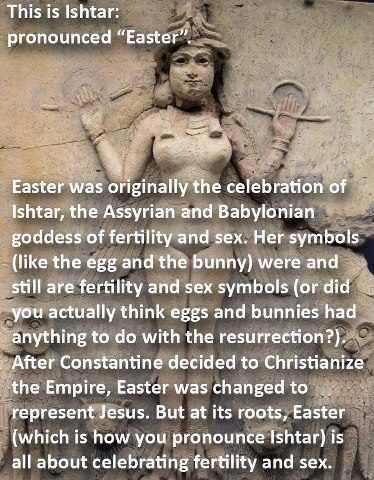
ishtarThe picture at right is one that many of you have seen this Easter, it’s making the rounds thanks to Richard Dawkins and his Foundation and there’s two things that bother me about it.

First of all – it’s wrong! There’s a lot of myth and misinformation in it. I’d go into the details myself but fellow blogger Anne Theriault over at The Belle Jar does a wonderful job of that HERE. So I won’t repeat it all, please go and read her excellent article.

But to address my other complaint, let’s assume for a moment that it’s all true; that long before Christianity came along there was a celebration of fertility and sex that included bunnies and eggs and then got reworked when Constantine had a religious experience and found God. My response to this semi-etymological revelation…

So What?

Seriously! What difference does it make? Constantine, when looking for a time to note the death of Jesus and celebrate his resurrection the Emperor of Rome chose to cancel the sex, drugs and rock’n’roll party and deal with a far more serious occasion. That doesn’t mean the Easter celebration is about sex!

Time passes. Things change. Peoples, governments, empires and even religions come and go. “Old things are passed away; behold, all things are made new”, Paul tells the Corinthians.

Just as the love of Christ makes changes in the life of an individual, so too changes happen in the life of a nation, or an empire. Rome moved on; it stopped worshiping the ad hoc collection of gods it had gleaned from Greece and every other nation it had conquered and by royal decree focused on the God of Abraham,  Issac and Jacob, the Father of Jesus Christ. A wholesale change took place in the religious culture of the time.

Did a few of the old customs hang on, helping to shape the rubrics of the new religion? Possibly; people are people after all. It’s hard to let go of the past. Incorporating a few of the old bells and whistles can make the transition easier for the man-in-the-street who doesn’t fully understand the reason for the changes being made. That doesn’t diminish the new significance; it simply makes it a point of contact for the common person.

It’s a lot like the building where my home church meets each Sunday and throughout the week. It started it’s tour of duty as University Village Public School, an open concept building were the neighbourhood kids came to learn, play and prepare for the future.

Today, it’s called Kortright Presbyterian Church and the happenings within the building aren’t all that different. Now people of all ages come to learn, play and prepare for the future; only on the spiritual level instead of the secular. We learn about who we are, where we came from and, by the grace of God, where we are going.

In like manner, if I may be so bold, it may well be the same with Easter. Is it all that bad if the Easter celebration was once a festival of sex and fertility? Think about it: if life is to continue, if there is to me another generation after this one, then sex and fertility have to be part of the equation somewhere along the line. Human love, expressed in sex between an man and a woman, results in new life. The death and resurrection, an expression of God’s love at Easter, also results in new life; new spiritual life, and the haters in the world are never going to diminish the meaning of that.

Happy Easter!

What Would MLK Do? Christians and Climate Change

In Canada, Martin Luther King Day is all but ignored. Oh, it is mentioned on talk radio and on the news; but it is rarely forefront in our collective consciousness because it is, after all, a U.S. holiday. With it falling on a Sunday this year, yesterday I barely noticed it, being wrapped up in my duties surrounding two morning services at Kortright Church.

I am grateful then for this article by Jarrod McKenna on Tony Campolo’s Red Letter Christians blog. It is my hope that I will be deeply considering his message for some time to come.

Red Letter Christians » What Would MLK Do? Christians and Climate Change.