The Man in the Plastic Mask – Our Story Continues

Well, as I reported last time this was the day we were to spend down in Hamilton getting things ready for my radiation treatments. And for a few moments there, we wondered if we’d even make it.

On Monday Roberta called the Cancer Society to arrange for a volunteer driver to take us down for my three appointments today. The lady at the Society’s office told us that something would be arranged and that the volunteer driver would call my cell phone with the details sometime Wednesday night to make the arrangements for Thursday. Well, by 9 pm last night the driver still hadn’t called and since we were starting to get concerned Roberta started phoning around looking for a ‘plan B’. Unfortunately, she wasn’t too clear on the fact that the first option had appeared to have fallen through, and a lot of folks thought we had simply left asking far too late. Once that little detail was cleared up and folks realized that it was a last minute ‘plan B’ we were looking for, response became more favourable. Sorry Folks!

Anyway, a back-up plan was found; a lawyer friend of ours was willing to let us borrow one of their cars so that Roberta and I could drive down ourselves. Since no actual treatment was going to take place this time (once the treatments start I can’t drive home afterward – must have a driver) driving ourselves was an option.

About 15 minutes after we had gotten off the phone with our friends, the Cancer Society driver finally called. Turns out she had called before (the house number-not my cell phone) but because of confidentiality constraints was unable to leave a message on the machine. Apparently, and this came as a surprise to Roberta and I, a great many cancer patients never tell their families about the disease. They go through weeks and weeks of treatments without ever telling anyone they have cancer; not their co-workers, not their children, not even their spouses. For this reason, the Cancer Society volunteers are not allowed to leave a phone message in case they accidently blow their client’s cover. And since, for some reason, the office had not given the coordinator my cell phone number, we had no idea they had been trying to contact us.

Anyway, we got things sorted out with the volunteer driver and had just finished calling our lawyer friend back to let them know everything was on track when the phone rang again. This time it’s the coordinator of the volunteer drivers for the Cancer Society. While we were on the phone calling our friends (for the second time) he was telling our driver that her schedule for the next day was going to be disrupted because another volunteer was suddenly unavailable. He was calling us because we had happened to mention to the driver that we had a ‘plan B’ in place and he was calling to see if we could still use our back-up plan because he needed our driver to go to Toronto instead of Hamilton.

So, back on the phone to the lawyer-friend and this morning he picked us up at the house; we dropped him off at the office and then Roberta and I were on the road to Hamilton with an extra 20 minutes to spare. God Bless ‘em, I don’t ever want to hear any of you bad-mouthing lawyers again! Lol

The rest of the day was largely uneventful, going pretty much as planned except for one interesting little quirk at the surgeon’s office. We were just checking in with the surgeon’s secretary when he stepped into her office and asked us “Why are you here? I was not expecting to see you until after your radiation treatments were finished.” Turns out the resident at the hospital who told us to make an appointment with the good doctor for two weeks after the surgery was just following standard protocol and Dr. Gupta didn’t actually want to see us at all; he was expecting the Juravinski Centre to handle all the follow-up until after the radiation therapy was complete.

Oh well, no harm done. We did have a nice little chat with him and one of his residents and were happy to have him confirm once again that the 16mm tumour was fully contained in the tonsil and was of the P16 variety of the HP (Human Papillomavirus) type of cancer, a type which responds very well to the radiation treatments and is highly curable. Given the track record of this treatment with this type of cancer no chemo-therapy and no additional surgery should be needed once the radiation regimen is complete. Yay!

The rest of the day went smoothly; nice visit with the rad-techs at the Juravinski as they made the mould by pressing this warm net of plastic over my face (see pic –Sorry, that’s not me, it’s a file pic from web-site. Mine looks just like it though.)
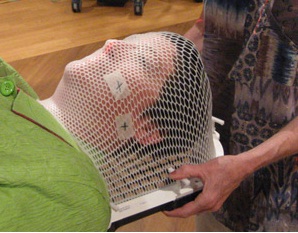
Man in the Plastic mask - not me, file pic from web site

Man in the Plastic mask - not me, file pic from web site

A quick lunch at Tim’s up the street and then back to the clinic for a CT-scan that will be used to help plan my regimen of treatments and be used to aim one of the 11 Varian Linear Accelerators that will be used to administer the radiation treatments.

Well, that’s about it I guess except that I would like to make one observation.

Both Roberta and I have spent a lot of time on the phone and talking to various help care types in both Guelph and Hamilton since this whole thing started almost a year ago, and we have both noticed the same thing. Dealing with the various components of Hamilton Health Sciences has been an amazing experience. The difference between there and here in Guelph is almost like night and day.

Now I want o make it clear that I’m not talking about the people here! I am sure that the people here in Guelph are every bit as dedicated and caring as the folks in Hamilton are; rather I’m talking about the system each are asked to work under. In Guelph we have found it very much a bureaucratic, institutional system. Lots of answering machines, few call backs, overworked staff, and few volunteers resulting in a process that is designed to treat as many people as possible but with comparatively little human interaction.

The Hamilton Health Sciences setup, from our experience anyway, seems to be much better coordinated in a customer-service orientation. We call down there and talk to people within only a few steps through the computer phone system. Everyone we work with seems to be relaxed and un-hurried, their first priority appearing to be making sure we understand everything and we’re still at least marginally within our comfort zone before going on to the next step.

And the volunteers absolutely blew us away. From folks at the information desks guiding you from one part of the hospital maze to another, to the lovely woman going from waiting room to waiting room handing out coffee, tea and cookies (she even got Roberta some hot water she could use to revive her Tim Horton’s green tea), all of them were absolutely amazing. I have never had so relaxing and calming an experience in a hospital or clinic before.

Since we had the same experience at both St. Joseph’s and the Juravinski centre, either they are both reading the same play-book or Hamilton Health Services has set up a wider policy of treating people like people. Whichever it is, from where I was sitting; in the waiting room, in the Mould Room, in the CT scanning room, someone is doing something right in Hamilton.

Like I said, I really don’t believe it’s the people. I think it’s the system they are each asked to work under, one that is institutionally designed to get the job done, and another that seems designed to put patient comfort first. And if, as one friend has suggested, the difference is because both St. Joseph’s and the Juravinski are publically funded, but privately run, then give me the privately run system every time.

Looking Forward to a Day in Hamilton

JCC totebag

My JCC tote-bag. One souvenir I cold do without.

Okay. I’m back from the latest trip to the clinic in Hamilton and here’s what’s what.

They did in fact find the cancer – it was hiding in my right tonsil. Seems they got the sucker when they took my tonsil out. They were just going in for a look-see because they suspected it might be there, and lo and behold it was. However, since this was just your garden variety tonsillectomy (in case they were wrong I guess) they did not burn out as much of the surrounding area as they would have done if they knew for sure they were removing a cancerous-type tumor.  And since the cyst proved little pieces of this thing are floating around in my lymphatic system, we must not leave anything to chance; so…

On with the radiation therapy! (Oh joy) I head back down Thursday next (Dec. 9th for those of you keeping notes) and engage in a day full of fun and excitement.

1st up – a trip to the surgeon’s at 9:30 am. (or 9:50 am – can’t read my wife’s hand writing and neither can she.  Will have to make a phone call on this one Monday) to make sure the charred flesh in my throat is healing nicely. That’s right, we want to be sure that my throat has fully recovered from the last atrocity inflicted upon it before we subject it to another one.

2nd on the itinerary – The Man in the Plastic Mask – Act 1.  At 11:15 a.m. our healthy, medically certified, and CLEAN-SHAVEN  hero (me) arrives up at the Juravinski Cancer Centre to get a cast made of my face using a special plastic mold. This will be used to keep yours truly from twitching while these high-tech William Tells try to shoot a cancer laden apple off my head with an arrow made of radiation. If I flinch we might wind up with an outcome decidedly different from the opera. Ouch! (Yes, I’m mixing my theatrical allusions here but I really don’t care.)

3rd in line – Lunch.  Apparently it takes an hour and a half for the cast to harden; during which time I am invited to have lunch, take a walk, whatever, so long as I am back for the second act.

4th item – The man in the Plastic Mask – Act 2.  Once the cast has hardened we return to the clinic where a CAT-scan of me in the mask will be taken. This will in turn be used to plot out the course of my radiation therapy sessions and pin-point EXACTLY where those aforementioned radioactive arrows will intersect with my anatomy. Then the mask will be marked with the indelible ink targets, instead of my face.

That done I am set free to roam the earth until the actual radiation treatments begin about 2 weeks later (specifics to follow on Dec. 9th) I am told all will proceed without incident for the first few weeks of treatment, after which the side effects will kick in and I’ll wish my mother had never given my father his first kiss (or some other event that would have precluded my birth so as to avoid all this unpleasantness).

Well, that’s the sum total of the information I have for now. This should be more than enough for the prayerful, the genuinely concerned, and the just plain curious until we write the next chapter. See you Dec 10th.


Guelph Waste Management Now Includes Bomb Disposal

Has this ever happened to you? You’re surfin’ the net, trying to find the recipe for Glazed Turnips you saw on Canada AM, when you stumble across a recipe for a homemade bomb.

“Wow,” you think to yourself,  “is that ever cool! I wonder if they’re hard to make?”

Checking out the instructions you discover it’s much easier than you had previously imagined. Thinking this would make a great science experiment for the kids you’re homeschooling you downoad the pdf, print out the instructions and before you can say “homeland security” you’ve got a nifty little extreme-urban-renewal device complete with digital timer. Now what?

I mean it’s not like you intended to use it, right? You weren’t going to actually blow up anything were you?  Okay, for a moment you thought about your neighbour with the yappy little dog-wanna-be that barks at every bird, butterfly and snowflake that comes near it’s yard, but in reality you just built it to see if you could. Now you need to get rid of it. So what do you do? Where do you turn?

Well this year in Guelph, Ontario (and most other parts of the province I suspect) you need look no further than your brand new community phonebook from Bell Canada. I’ll admit, I’m not much of a phone book user these days, finding all the information I need on the web. In fact, I can’t even tell you exatly where ours is at home right now. However, when the new phone books arrived at the shop today, I took a few moments to flip through and check that they spelled my name right. (Oh Come on; don’t be like that! You do it too, you know you do.)

Right at the front of the book I noticed a rather large section on waste management, recycling and Guelph’s 3 bags-of-separation curb pick-up program. Now, let me say that I was somewhat impressed as it is the most thorough explaination of what goes where, when  and how that I think I’ve ever seen. There’s not only sections on what can go curbside in which colour of bag and what can’t; there is also a lengthy list of various corporations, businesses and organizations that will help you get rid of all the refuse of our overly consumptive lives that pose a threat to good ol’ Mother Nature and can’t be put curbside, including homemade bombs.

Section L8 Page 17 Guelph Phone Book

Section L8 Page 17

Yes friends, it surprised me too; but there it was, in Section L8 on page 17 of the Green Pages, complete with photo illustration (see pic at right) – a handy tip on what to do with Homeschool Science Experiment #235 –  drop it off at your Local Police Station!

And while you’re at it why don’t you take those unspent shotgun cartridges Uncle Fred left between the cushions of the sofa when he fell asleep after Thanksgiving dinner. Or better yet, if I may offer a suggestion, why not have your lawyer drop it off for you and avoid all those pesky questions I’m sure the officer on the front desk will have as you strive to be a greener citizen.

It certainly is good to know that all our bases are covered when it comes to Guelph’s Waste Management program. Why, even urban terrorists can do their part in creating a greener tomorrow. But then what else would you expect from a government as thorough and efficient as ours?

BTW.. did you also know there’s a line for reporting “bribes” on your income tax return?

Until next time…

Towards Cycling Culture

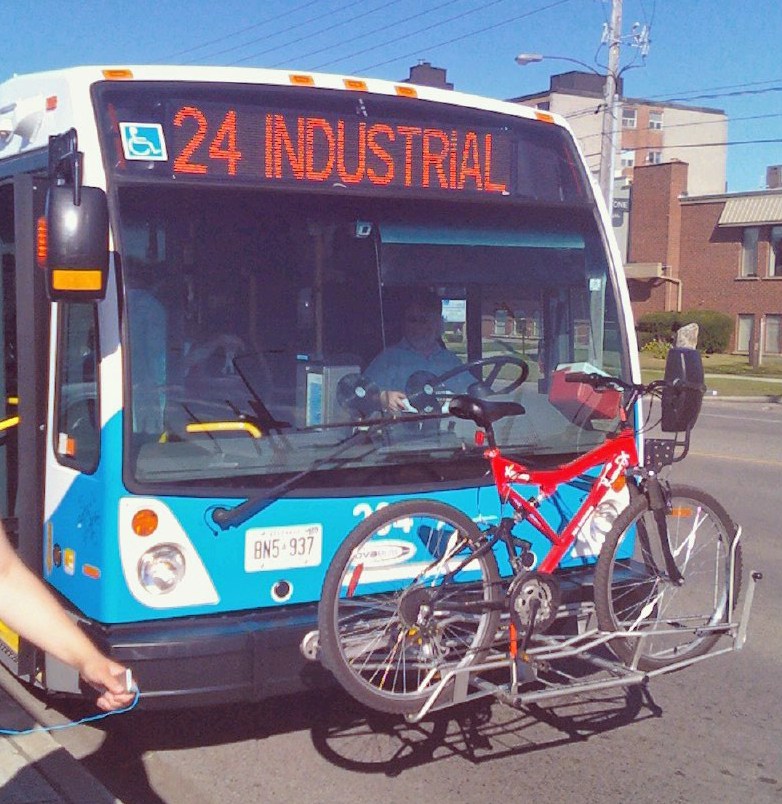
As I make my way down the final stretch to the Ride to Conquer Cancer, I find myself pondering the move towards cycle culture in North America and why it isn’t more like Europe?

For the last year or so I’ve been following a blog called Copenhagenize.  Written by an ex-Calgarian now living in Copenhagen, it and it’s sister site Copenhagen Cycle Chic chronicle how Danish cycle-culture is progressing and Copenhagen in particular should be the model the rest of the world uses to shape cycling infrastructure in the big cities. To be fair, there’s a great deal I like about what Mikael has to say, and I certainly would like to see Canada follow more of the Danish example when it comes to cycling infrastructure; separated bike lanes, extensive bicycle parking at malls and public buildings, elimination of helmet laws, etc.  But there is one major difference between Europe and North America that will likely always stand in the way.

Europe moves at a much slower pace.

It’s a mindset thing. Throughout most of Europe things happen when they happen. Deadlines are largely regarded as suggestions, stress relief often involves coffee in a street cafe in the middle of the afternoon, shops will even close in the middle of the day to take in a soccer game or a concert.  The trip to the shop or office is as much an experience as being there.

Not so in North America.  Here it’s all about getting as much done as possible in as short a time as possible.  Fulfillment is found not in relishing every moment of an experience but rather in cramming as many experiences into the moment as possible.  North America has always had a quantity over quality mindset. The daily commute, the trip to the store is a means to an end and nothing more. We get from A to B is as few steps as Google Maps can lay out for us and it better not take one second longer than the estimate.

Even what passes for cycling culture reflects this.   The mainstay of the European bicycle commute is the city-bike.  Ridden by men and women alike it allows one to travel in style; long coats, skirts, pumps and even stilettos are suitable cycling fashion. For families, the bakfeit or cargo bike allows mom or dad to ferry the kids around in safety without ever having to take the eyes of the hope of the future.

In North America however, it’s all Spandex and helmets, 27 speeds and razor thin tires, beat the rush and get to the office in time to grab a shower and wash away the record setting attempt at getting to work.  Kids interrupt air-flow so tuck ’em in back or park ’em in a trailer out of sight so we can focus on the road ahead.  Slow bikes are as much an annoyance as slow drivers and cycle chic is measured in Day-Glo jerseys and the latest high-tech shoe clips.

As long as this is the case I’m afraid that cycling culture in Canada will always be at war with the cars.  Bicycles don’t mesh with North Americas high speed lifestyle. It’s hard to embrace the bicycle when you want to be everywhere 10 minutes before you left and want to take half the house with you in case you need something.

Slow Bike Movement

Slow Bike Movement

If North America is ever going to move towards a vibrant effective bicycle culture the first thing it needs to do is slow down. Not just on the roads but in the way we approach life itself.

“Slow down, you move too fast.
You got to make the morning last.”

See you in Niagara Falls —

How far we have come… or have we?

Among the many shades of gray that make up my reality we find my role as technical director for Kortright Presbyterian Church in Guelph. This role requires that I try to keep abreast of what’s what in the world of technology, such as Audio and Video systems, Computer developments, and of course, the Internet.

In regard to the third item on that list one question that pops up from time to time is, “Just how big is the Internet anyway?” I’m sure if you haven’t actually had this discussion with anyone, you have probably wondered about it at least once in your life. So here then, presented for your perusal, are the latest figures from Pingdom, an Internet uptime monitoring firm in Sweden that is very good at keeping track of this sort of thing. The blog article can be found here, but the following are some of the highlights.

Email
1.3 billion – The number of email users worldwide.
210 billion – The number of emails sent per day in 2008.
70% – The percentage of emails that are spam.

Websites
186,727,854 – The number of websites on the Internet in December 2008.
31.5 million – The number of websites added during 2008.

Domain names
77.5 million – .COM domain names at the end of 2008.
11.8 million – .NET domain names at the end of 2008.
7.2 million – .ORG domain names at the end of 2008.
174 million – The number of domain names across all top-level domains.

Internet users
1,463,632,361 – The number of Internet users worldwide.
248,241,969 – Internet users in North America.

Blogs
133 million – The number of blogs on the Internet (as tracked by Technorati).
900,000 – The number of new blog posts in a day.

Images
19.2 billion – Photos hosted by Facebook, Flickr, and Photobucket. (my note: This actually represents a small percentage of the images available when you consider these three only account for 3 out of 174 million web domains.)

Videos
12.7 billion – The number of online videos watched by American Internet users in a month.
34% – The increase in viewing of online video in USA compared to 2007.

Malicious software
1 million – The number of computer viruses in April 2008.
468% – The increase in malicious code compared to 2007.

With an estimated world population of 6,706,993,152 (according to the CIA) the above figure means roughly 22% of Humanity is connected to the World Wide Web which is 16% larger than a year ago, 1 in 5 of us don’t write letters much anymore, North America has only 17% of the Internet population, and yours truly constitutes a mere 0.000002% of the Blogosphere. How’s that for a little perspective?

But while these numbers remind me just how small a part of the whole I am, they also remind me of just how quickly our world is shrinking. (I’m going to do a little ‘old guy’ shtick here so be warned and bear with me.)

You see when I was a kid, long distance phone calls from England were still a really big thing. The whole family would gather round and wait almost breathlessly for our turn to say ‘Hi’ to Grandma and Grandpa. I’d get a letter from my penpal in Australia about every other month. When I did get a letter from him the information was already at least two weeks old. The encyclopedia set my parents bought me for high school cost over $1000 dollars and was somewhat out of date by the time I finished.

Now, well you know how it is; through Skype I call a number of people all over the world every day and gripe if the sound quality isn’t up to my 128bit 44.1kHz standard, Facebook’s status line tells me what my friends in Malawi were doing as little as 30 seconds ago, and about $50/year gives me access to the entire reference edition of Encyclopedia Britannica which is constantly updated month to month.

So, what’s my point? Well, the scriptures tell us that God separated the people at the tower of Babel because as one unified force they were getting ideas too big for them to handle. They began to think there was nothing they couldn’t do and were losing perspective as to where they fit into the grand scheme of things. They began to think of themselves as gods. So God confused their language making it harder for them to communicate and therefore harder for them to collaborate on the insanely big stuff, like skyscrapers.

Today technology is reversing what happened at Babel. Every year we grow closer to being a true world-wide community. Every year scientists, engineers and guys tinkering around in the garage (yes that still happens) build on each other’s work to create ever increasingly spectacular feats of technology, some of which has us once again infringing on God’s domain.

In his book ‘Unceasing Worship’ Harold Best points out that we are all worshiping all the time. It is the nature of our being to worship. The key point is who do we worship at this moment, the Creator or the creature. As I watch technology continue to progress I can fully appreciate the temptation to self-worship. We have accomplished a great deal in the lifetime of the human race, and it does indeed seem that there are no limits as to what we might accomplish in the future. But I would ask us all, my self included, to remember that for all our creativity we are only building on what God has done before us.

You see, it’s not about skyscrapers – it’s about how we think of ourselves, and our place in God’s creation. We have learned to do marvelous things with resources such as iron, oil and silicone; but we still have to go looking for them because we have not learned to make them. Only God can do that. We can clone a sheep named Dolly and engineer a tougher tomato by introducing animal genes to its DNA; but we still can’t create life out of lifelessness. Only God can do that. We can communicate ideas, and pack a million calculations into ever more infinitesimal periods of time; but we can’t stop time from rolling on or reverse it’s direction. Only God can do that.

And dispite all the advances in technology we have made, in one thing we have not advanced hardly at all. What has not changed is our propensity to use our creativity to find ever more inventive ways of hurting, oppressing, and killing each other. Despite our best efforts to the contrary greed, pride and ego remain the most prevalent motivations for our advancing technologies. We find we cannot escape the nature of our fallen existence as we continue to exert our superiority over the planet and each other. We cannot wash away the stain of what humanity has done with its creations over the millennia. We do not have within us the capacity to make right the burden of sin that we have created by how we treat each other and our planet.

Only God can do that.